Best early takedown of Dianetics? Perhaps this gem from the great Carey McWilliams

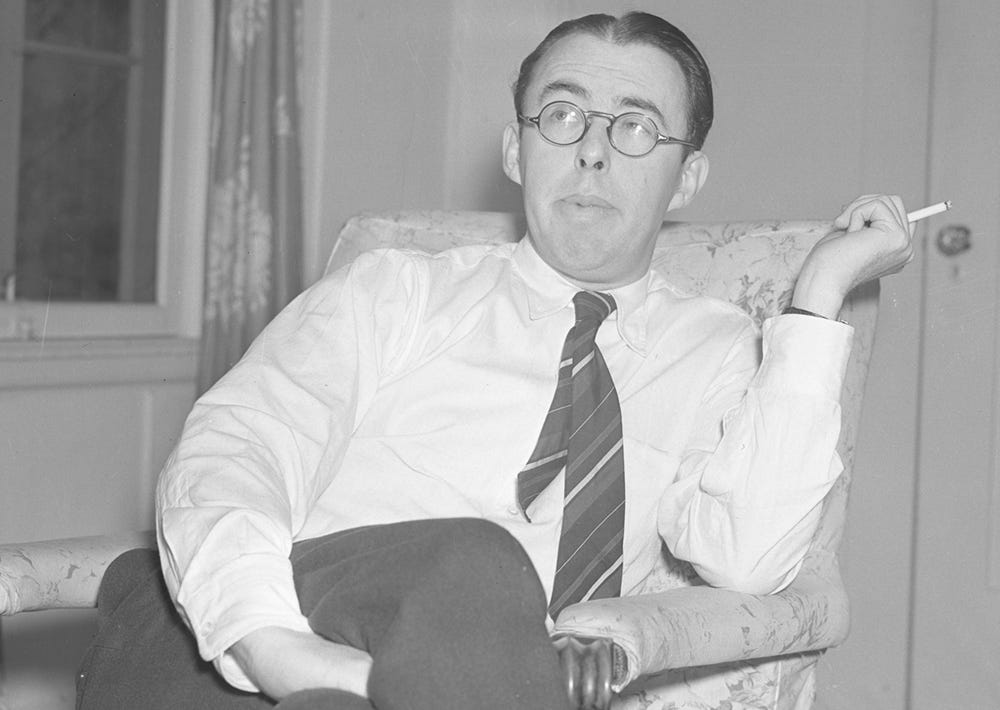
Until a researcher friend brought this to our attention, we had no idea that the great Carey McWilliams, the California journalist whose book Factories in the Field preceded John Steinbeck’s Grapes of Wrath by a few months, and who raised awareness of the injustice of Japanese internment during WWII, had at one point turned his attention to L. Ron Hubbard.
In January 1951, 75 years ago this month, McWilliams wrote a superb takedown of Hubbard’s bestseller Dianetics for the journal Frontier just as dianetic fervor was reaching its initial peak in LA.
We thought you’d enjoy this skewering of Hubbard and his flim-flammery from one of the very best observers of the time.
DIANETICS: the trouble-born quick-cure, without the religious trappings, brings back memories of Aimee and the Utopians
by Carey McWilliams
A GROWING fad in various parts of the country, dianetics is a flourishing cult in Southern California.
Not since the spectacular rise and fall of the Utopian Society in the middle 1930s has Los Angeles fallen so hard, and so fast, as it has for this latest cult.
Dianetics has been described as a cut-rate bargain-basement therapy; a form of “home-psychoanalysis”; “a technocracy of the mind.” With the help of certain simple skills and techniques, the emotionally distressed can achieve “release” within less than twenty hours and thereby become “dianetic clears” or perfectly normal persons. Those who have not been “cleared” are known, in the jargon of the cult, as “pre-clears.” The pre-clear’s difficulties stem from “engrams” which are defined as injuries to the body which occurred when the mind was unconscious. Engrams are removed or “cleared” by having the pre-clear re-experience the traumatic experience or incident in a state of “dianetic reverie.” As an unregenerate pre-clear, full of skeptical aberrations, I confess that this description is most inadequate; it is intended merely as a verbal and ideological guide to the rest of this piece.
The founder of the new cult of dianetics, L. (for Lafayette) Ron Hubbard, was born in Tilden, Nebraska, in 1911. After taking a degree in chemical engineering at George Washington University, he went to sea as “Supercargo General” — his phrase — and later served as leader for “several scientific expeditions,” including “the Caribbean Motion Picture Expedition” and “the West Indies Mineral Survey Expedition of 1934.”
During World War II, he served as commanding officer of several escort vessels and, for a time, was Navigation Officer of the U.S.S. Algol. The bible of the new cult, of course, is Hubbard’s best-selling book: Dianetics, The Modern Science of Mental Health, dedicated to Will Durant and described by the author as “merely one chapter” (of 439-pages) of a much larger opus on epistemology.
According to Hubbard, the handbook on dianetics was completed in 1938 but “for obvious reasons had to be kept under wraps for twelve years” which may simply mean that he had difficulty in finding a publisher.
Hubbard, who refers to himself as a mathematician, is a writer of science fantasy fiction. Samples of his work may be found in Thrilling Wonder Stories for October, 1949
(“The Planet Makers”) and Astounding Science Fiction for February, 1950 (“To The Stars”). Nowadays about a third of the writers who fill the ever-growing demand for science fantasy fiction or “improbabilia” reside in Southern California. According to Ward Moore, an expert and reliable guide, the most peculiar way in which “improbabilia” differs from other forms of fiction is in the devoted attitude of its readers. “Avid readers,” he writes, “are not content with snatching the magazines and books as they come from the press; they form themselves into clubs and societies whose whole purpose is discussion and analysis of the medium.”
So-called “fanzines,” multigraphed, mimeo-graphed or hectographed, have an amazing circulation and — more amazing — a large part of it is paid. Some ten or twelve “fanzines” are published in Southern California and the Los Angeles Science-Fantasy Society, which Hubbard addressed in 1949, boasts that it has held some 600 meetings in the last fifteen years. Dianetics was really launched, as a movement or cult, with a brief article on the subject which appeared in Science Fiction for May, 1950, and many of its earliest devotees were “fanzine” enthusiasts.
Weaver of Fantasy
Among improbabilia fans of my acquaintance, Hubbard is known as an extremely prolific but quite colorless and mediocre weaver of science fantasy yarns who has published fifty or more stories and a number of novels in this genre, some of his work appearing under the name of Réne Lafayette. Most of the Réne Lafayette stories have to do with benevolent dictators of one kind or another; for example, an oligarchy of medical men, who enjoy immortality and are possessed of infinite wisdom and knowledge. Among the Hubbard novels are: Death’s Deputy; The Kingslayer; Buckskin Brigades; Triton; Final Blackout; and Slaves of Self. The California representative of the Hubbard Dianetic Foundation is the semanticist, A. E. Van Vogt, who is also an industrious composer of improbabilia (Masters of Time, Slan, The World of Null A), and whose wife, E. Mayne Hull, also writes in this field. Many Southern California practitioners of improbabilia are represented by Forrest Ackerman, a Los Angeles literary agent, who is actively interested in the promotion of dianetics.
Dianetics seems to have issued directly from the realm of fantasy — if one can believe a story which is told by local devotees of the cult.
It seems that Hubbard died during World War II but that his astral body rose from the dead. A voice — perhaps a liberated engram —commanded this astral body to look behind a door where all knowledge might be seen, spread out like food on a banquet table. Once the astral body returned to its mortal frame, Hubbard “rose from the dead” and was assured by a circle of attendant nurses and physicians that he had been dead for seven minutes. The huge work on epistemology, of which the dianetics handbook is merely one chapter, is said to be the record of what he saw beyond the door — in dianetic reverie.
Within the last three months, Los Angeles has begun to jump and bounce with dianetic energy. Therapy teams and triads have multiplied with incredible rapidity and small house meetings have grown into lecture and forum series in neighborhood theaters and large auditoriums.
I got my first eager glimpse of the dianeticians at the Campus Theater, near City College, on August 6th. On this occasion, five or six hundred people paid sixty cents admission to hear a forum discussion of the new therapy. They were mostly young people, of the 20-to-30 age bracket, who came in pairs, and there seemed to be more young men than young women. I could see only a sprinkling of chronic cultists. From the questions, which were eager, intelligent, and to the point, it was clear that most of the audience was familiar with Hubbard’s book; indeed most of them carried copies and also notebooks in which they scribbled with great diligence.
It was obvious that the meeting had been carefully planned and timed to achieve a crisp, snappy tone. It was opened by a well-known local semanticist — semanticists seem to have an affinity for dianetics — who gave a brief pep talk. Four professional “auditors”, whose training ranged from seventy to three hundred hours of “auditing,” then made short statements about the theory and practice of dianetics. It was explained that a branch of the Hubbard Dianetic Research Foundation had been opened in Los Angeles to give a hundred enrollees an intensive four-weeks course, for a fee of $500, so that they might become professional auditors. It was also explained that the branch is staffed by graduates of a thirty-day intensive training course conducted by the parent foundation in New Jersey.
At a lower level, teams of auditors, who intend to audit each other, can enroll in a course which lasts a week and costs $250.
For those who cannot afford this fee, professional auditing services are available (from $15 to $25 an hour); night classes are offered at fees ranging from $3 to $5 a week; and Hubbard’s text can be purchased at $4 or copies obtained from rental or public libraries.
“Oiling The Time Track”
Listening to the speakers, I became aware of the amazing tricks and delusions which can be produced by the consistent use of a highly specialized vocabulary. Words and phrases like “engram,” “pre-clear,” “aberrated,” “demon circuit,” “standard memory bank,” and “cellular level engrams,” have been given arbitrarily defined meanings. And the definitions are so arbitrary that an acceptance of the jargon is tantamount to an acceptance of the ideology; on the other hand, if you reject the special vocabulary, you cannot understand dianetics.
The consistent use of this specialized vocabulary also tends to conceal the fact that dianetics is a hodge-podge of psychoanalysis, semantics, cybernetics, and, curiously enough, of technocracy. Constant use was made of such expressions as “oiling the time-track,” “running an engram,” “dubbing in,” “tinkering,” “engineering” and stress was placed on “optimum efficiency” and the speed of the therapy. “Time-track” was used with much the same import as “sound track” and one got the impression that “engrams” are a kind of emotional “static.” Finger-snapping seems to be an important auditing technique: several speakers, for example, laughingly exhibited fingers swollen or sore from constant snapping. Even in speaking, some of the auditors kept snapping their fingers.
The dianetic auditor is not the listening analyst; on the contrary, he is the technocrat of the mind, the emotional engineer, the authoritarian mentor. “Engrams” are discussed in highly personalized terms, as though they were wicked and scheming Lilliputians that must be driven from the psyche much as the followers of the MIGHTY I AM cult “blast” static from their souls. Yet aside from the verbal mumbo-jumbo, the meeting was devoid of the usual cultic nonsense; there was no off-stage “music of the spheres,” or colored lighting effects, or mystic roses. Indeed the meetings sponsored by the Hubbard Foundation clearly aim at producing an appearance of complete rationality, scientific objectivity, and an impersonal machine-like competence. The social element — conspicuous in all cults that succeed in Southern California — was apparent in the chattiness of the audience during the intermission and in the arrangements which had been made for “pre-clears” to meet “auditors” living in the same neighborhood. In Los Angeles, Technocracy Inc., has provided sound equipment, and performed other services, for the devotees of the new cult.
On August 10th around 6,500 Angelenos paid $1 admission to attend L. Ron Hubbard’s first public lecture — at the Shrine Auditorium. With fifteen local dianeticians seated on the platform as an official retinue, the founder of the cult — a young man with a shock of red hair, a most agreeable speaking voice, and the assurance of a floor-walker — walked out from the wings and took charge of the meeting without any preliminary formalities or introductions. He was at some pains to explain that the royalties from the sale of his book go to the Hubbard Foundation from which he receives a drawing account of $500 a month. He was somewhat defensive, too, about the book: the publisher had cut out the acknowledgment (to Freud, Herbert Spencer, Bacon, Plato, “and others”), the section on the mathematics of dianetics, and the important case histories. To date Hubbard has only found one hold-out among the thousands who have been treated with dianetic therapy: a stubborn so-and-so, from St. Louis, who appears to be hopelessly stuck on the time-track.
Hubbard is Not a “CLEAR”
Hubbard made it clear that he is not a “clear” or, to be more exact, that he is not yet fully cleared. However his wife has treated him with excellent results, using amnesia trance therapy. He has so far recovered, in fact, from a condition of spinal arthritis that the Navy recently withdrew a disability allowance of $225 a month. He has never claimed, as reported, that cavities can be restored in teeth by dianetic therapy but there are dentists who have made this claim. Nor does he claim that his four-months-old son is a prodigy although it is true that the baby, “born in silence,” without forceps, instruments, surgery or anaesthetics,” is extraordinarily alert . . .
During the question period, Hubbard curtly observed that he was not in Los Angeles to stage “a good old Aimee Semple McPherson show” but, despite the gratuitous denial, a fine show was staged, all the same. The first act consisted in a demonstration of the “straight memory recall” technique. The lady who took the part of the pre-clear was not “sonic” and the interview with Hubbard proceeded rather haltingly. The pre-clear did confess, however, that she suffered great emotional pain from the fact that her mother had once said that she resembled her “Aunt Gladys.” In conducting a second public interview, Hubbard was interrupted by a young man in the audience who demanded that he should be permitted to play the part of the pre-clear. Marching to the platform with a black Pekinese tucked under his arm, he turned out to be a most uncooperative and somewhat exhibitionistic pre-clear and was soon dismissed. A couch was then rolled on stage and, with a beautiful young blonde as the pre-clear, Hubbard proceeded to demonstrate the technique of placing the pre-clear in “dianetic reverie.” With the self-composure of an actress, the blonde gave a husky-voiced, langorous recital of a “pleasurable incident” at the beach with a young man in wine-colored swimming trunks. The staging, here, was superb: one could have heard a pin drop in the vast crowded auditorium.
As the climax to the meeting, Hubbard summoned a “clear” from the wings: one Sophia Bianca, from Boston, “a Wellesley student,” elegantly gowned, dianetically composed, and most attractive. As a “clear,” Miss Bianca should have been able to demonstrate total memory recall — as the audience requested — but, in the lassitude of Southern California, she seemed to suffer from some engramic interference. However, the audience applauded loudly — for her gallant efforts and also for her good looks. Thereupon Lafayette Ron Hubbard, explorer, mathematician, metaphysician, science fantasy writer, and therapist extraordinary, strode to the wings and the meeting was over.
Watching this amazing performance, 1 was reminded of Thomas Mann’s story of “Mario and the Magician”; of William Dudley Pelley’s recital of the strange psychic experiences which he had experienced in Southern California when he, too, was a writer of fantasy fiction; and, most persistently, I thought of Aimee Semple McPherson and the great meetings she had staged, and the “miracles” she had performed, in the 1920s. I kept thinking, also, of the “cycles” of the Utopian Society which I had seen performed in the mid-thirties in this same auditorium. But the crowd that gathered to hear Hubbard was not made up of the same people who had cheered Aimee and applauded the Utopians. A new generation was in the auditorium now: young, literate, eager, but quite as gullible as the generation that Aimee entertained. The religious trappings had been removed but there was the same messianic eagerness, the same showmanship, the same appeal to the miraculous, and the same attraction of the painless and inexpensive cure. The main difference seemed to be that this audience was not seeking to achieve redemption through a conviction of sin but a quick and painless “release from nervous tension.”
The Basic Motivations
The dynamic behind the will to believe in dianetics is clearly the fear of death, of war, of atomic destruction, and the hope of “survival.” The ideology of the movement stresses the fact that the world is, full of aberration; that aberrated minds occupy high posts in the governments of the world; and that an engram might well “command” one of these officials to launch an atomic war, Since time is running out, the only hope of survival consists in a wholesale clearing of aberration. At one meeting I attended, a speaker characterized dianetics as “Operation Penetration”: a movement that was to penetrate all social strata and to remove, as rapidly as possible, the engrams that are driving the world toward a form of mass suicide.
Dianetics also has the appeal of a new ideological gadget, which doesn’t cost much, involves few commitments, has not yet been branded “subversive,” and might just work, you never know. At one meeting a young man, freely confessing that he was not a clear, explained the appeal of dianetics in this way.
“Like most of you,” he said, “I am a straw-catcher; I grab at every straw that comes along, hoping that I’ll get my hands on something that will work.” Thousands of young straw-catchers in this aberrated world are eager to buy a patented, packaged formula for salvation. To the aberrated, the aberration that is dianetics appears as a crystal-clear explanation of the confusion that rules the world. In the fantasies of dianetics, the sub-surface tensions and anxieties of our time are acted out and dramatized and the actors doubtless do achieve some “release of nervous tension.” Nevertheless the spectacular success of dianetics is, as Dr. Martin Gumpert has pointed out, “frightening proof of the confusion of the contemporary mind and its tendency to fall prey to pseudo-scientific concepts.”
On August 21st, Dr. David Seabury of Sequoia University. Los Angeles, conferred an honorary doctorate degree upon L. Ron Hubbard. Sequoia University is a metaphysical institution of the kind that has long flourished in Southern California. Many of its graduates live to be as old as Sequoia trees and recently Tatzumbie, “a Piute Indian Princess,” graduated at the age of a hundred and one years. The Golden Age, bulletin of Sequoia University, “devoted to Semper Videns — through Mental Peace, Physical Health and Continued Activity,” now advertises “dianetic therapy” through the use of a special B-1 (Thiamine), 3 F Food Supplement — “a lot of vitamins for a little money.” Dianetics is a lot of therapy for a little money.
Responses:
No Degree
Sir,
I have recently been told that ... you published an article by Carey McWilliams, called “The New Gadget: Dianetics” (January), and that in the article there is a statement that I gave a PhD degree to Ron Hubbard last summer ... I gave no such degree, and I have never at any time had a good word to say for Dianetics. On the contrary, two teachers of the David Seabury School of Psychology were dropped from the faculty because of their interest in Dianetics, and I stated last winter to the whole student body that I was definitely against Dianetics and all it stood for, and that the School would have nothing to do with it...Mr. Randall of the Hollywood Town Meeting got the idea that I would be willing to grant Ron Hubbard a degree, and he, or someone, sent out notices to that effect... I knew nothing of this at the time.
David Seabury
Mr. McWilliams replies:
On Aug 9, 1950, I received through the mails a printed announcement from the Hollywood Town Meeting that on Saturday, August 12, at the Troupers Club, 1625 N. La Brea, L. Ron Hubbard, “in a special cap and gown ceremony,” would receive an honorary doctorate degree from Sequoia University and that Dr. David Seabury would confer the degree. I am sorry to learn that Mr. Hubbard did not receive the degree which his contributions to science so clearly merit. But I insist that - even in Los Angeles - one should be entitled to take an announcement of this kind at face value.
Nothing in Common
Sir,
We read with interest your report on “Dianetics” (by Carey McWilliams) in the January 1951 issue of Frontier magazine. Whatever you may think of Technocracy, we would like you to understand that Technocracy, Inc. has nothing in common with “Dianetics,” and in no way offers it assistance or sponsorship..
Wilton Ivie
Assistant Secretary
Technocracy Inc.
New York City
Isn’t that great fun? Thank you again to the researcher who tracked it down. We’ll just point out that in August 1950 L. Ron Hubbard had a four-month-old daughter, Alexis Valerie, by his second wife Sara Northrup, and not a son. (He also had a son and daughter from his first marriage who were teenagers in 1950.) Also, that the woman who was promoted at that demonstration in Los Angeles as the first “Clear” was Sonya Bianchi, not Sophia Bianca. — T.O.
Want to help?
Please consider joining the Underground Bunker as a paid subscriber. Your $7 a month will go a long way to helping this news project stay independent, and you’ll get access to our special podcast series…
Group Therapy: Our round table of rowdy regulars discussing the week’s news, which drops each Sunday at noon.

Also, you can support the Underground Bunker with a Paypal contribution to bunkerfund@tonyortega.org, an account administered by the Bunker’s attorney, Scott Pilutik. And by request, this is our Venmo link, and for Zelle, please use (tonyo94 AT gmail). E-mail tips to tonyo94@gmail.com. Find us at Threads: tony.ortega.1044 and Bluesky: @tonyortega.bsky.social
For the full picture of what’s happening today in the world of Scientology, please join the conversation at tonyortega.org, where we’ve been reporting daily on David Miscavige’s cabal since 2012. There you’ll find additional stories, and our popular regular daily features:
Source Code: Actual things founder L. Ron Hubbard said on this date in history
Avast, Ye Mateys: Snapshots from Scientology’s years at sea
Overheard in the Freezone: Indie Hubbardism, one thought at a time
Past is Prologue: From this week in history at alt.religion.scientology
Random Howdy: Your daily dose of the Captain
Here’s the link for today’s post at tonyortega.org
And whatever you do, subscribe to this Substack so you get our breaking stories and daily features right to your email inbox every morning.
A "straw-catcher". That definitively describes it.
If you didn't live through the fifties, it is hard to describe the terrifying undercurrent of pure existentialism that informed every part of it. I was just a kid, and I understand those who see the classic black-and-white sales billboard with the "nuclear family" gathered around the breakfast table as iconic of that time. Or the Eisenhower-inspired pictures of the amazing interstate freeway system.
I think it was Peter S Beagle who said something like "Even the pretty ballon needs a knot at one end." The knot that held the Lucille Ball generation together was the terror of nuclear annihilation.
Somehow the terror of it has faded, though it is still a clear and present danger. We have new existential terrors today, possibly not as horrific as the one that inspired the Joan Baez "Just a Little Rain" song. But I think every generation has its iconic fears and hopes. There seems to be something broken.
If you're paying attention and not simply lost in the opiates of the people (Marx's name for religion but it also applies to other idols like the Super Bowl and The Batchelor), the world is a scary place. It makes sense to feel a little lost sometimes and willing to grasp at any straw that looks even remotely plausible.
Hubbard was just riding the zeitgeist of his time by calling it "scientific". Like those that sold nostrums containing radium to cure all ills, he wanted to ride the technocratic wave. If we can pierce the stratosphere, and prevent polio, what else can science do? Seemingly anything, including solving criminality, insanity and war.
He was a world-class liar and couldn't even solve his daily finances, let alone the troubles of the nuclear age. But stop sometimes and think of those who saw a straw to clutch at when they heard him. A tiny ray of hope in a storm-tossed dark sky of insanity.
Is a false hope better than utter despair? No, because false hope leads to fanaticism and very poor decisions. But despair is no good either.
I would say, find some hope in the little things you can do for those near to you, not even trying to solve the big issues that are beyond you anyway. Catch the straws that land in your neighborhood. Just my two cents, your mileage may vary.
Carey McWilliams understood Hubbard very well. "quite colorless and mediocre weaver of science fantasy yarns." Nailed it.
This paragraph nails the early interest in Dianetics perfectly.
" the same messianic eagerness, the same showmanship, the same appeal to the miraculous, and the same attraction of the painless and inexpensive cure. The main difference seemed to be that this audience was not seeking to achieve redemption through a conviction of sin but a quick and painless “release from nervous tension.”
The Hubster 'cured' his audience of 'cooties'. After first infecting them with that imaginary 'disease'.
Carey's take on the Hubbard produced show is very telling. All I see are the old 'medicine show' tactics used to lull the audience into acceptance of the 'miracle cure'.
Carey got the $cieno redefinition of words and nailed their use very well. I propose that the Bunker issue a yearly prize named after McWillians for the best take down of $cientology. The prize could be something as simple as a Amazon gift card worth two cents.