
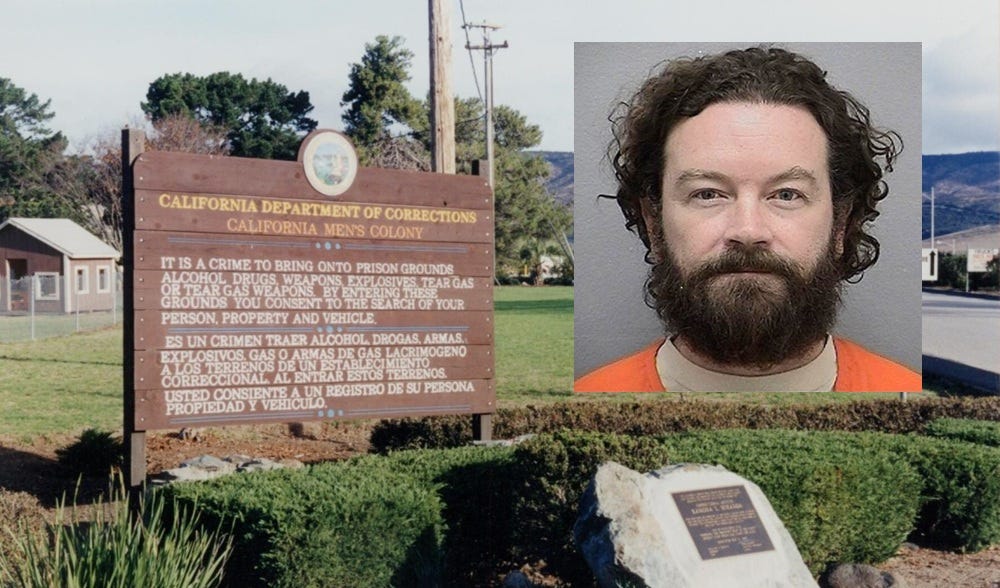
Last week we brought you the California Attorney General’s 42,000-word response to Danny Masterson’s criminal appeal. Masterson was convicted in 2023 and is serving a 30 years-to-life sentence at the Men’s Colony in San Luis Obispo. He’s trying to get a new trial or to walk out of prison entirely with his appeal, but we asked appellate attorney TX Lawyer to give his assessment of the AG’s response. Here are his thoughts…
It sucks to be a criminal trying to overturn your conviction on appeal. At trial, all the presumptions run in favor of the defendant, and the prosecution has to prove everything to the jury beyond a reasonable doubt. If they can’t do that to the jury’s satisfaction, the defendant walks.
Not so on appeal. Now, everything flips against you. All the evidence is looked at in the light most favorable to the jury’s verdict. The judge’s evidentiary rulings only matter if they rise to the level of abuse of discretion, and even that won’t do the defendant any good unless the appeals court decides any error in the evidence likely caused the jury to render an improper verdict.
Where the defendant’s best hope lies on appeal is with the points of legal error. A trial judge has no discretion to mess up on questions of law or instructing the jury on what the law is. Danny Masterson has precisely one point of error on the law. It’s the statute of limitations. If he wins that argument, he goes free. Everything else is just retrial material. And having read the briefing on both sides, I do not think Danny Masterson is going to prevail on the statute of limitations.
The whole issue turns on the statutory language of two different parts of the California Penal Code, sections 799 and 805. Section 799 says that if the maximum penalty for a crime is life in prison, there is no limitation on when the defendant can be charged. But section 805 says that in determining what the maximum penalty is, the court has to exclude any “enhancement,” i.e., additional factors that can make the sentence even longer for the defendant. You typically see sentencing enhancements around issues like whether a firearm was involved or the victim was a minor, that sort of thing.
Masterson’s argument is that the statute of limitations for forcible rape is six years, and the state only reached the maximum sentence of life in prison due to the “enhancement” of charging him with multiple rapes. That’s the only way he gets to the maximum of a life sentence, so in his view, that has to be an “enhancement” that gets disregarded for statute of limitations purposes. The state disagrees, and it has the better of the argument, in my view.
The state’s position is that Danny was not sentenced to extra time by an enhancement, but instead by operation of a wholly different sentencing scheme that only applies to him because he was charged with, and convicted of, multiple rapes. And the state appears to have case law on their side, quoting the California Supreme Court: “Unlike an enhancement, which provides for an additional term of imprisonment, [a penalty provision] sets forth an alternate penalty for the underlying felony itself, when the jury has determined that the defendant has satisfied the conditions specified in the statute.” In essence, the defendant is only getting sentenced for the rapes, he’s just eligible for a longer maximum sentence under the One Strike statute because he did it multiple times.
I can see how that distinction may be a little hazy in practice, but the other thing it has going for it is that in enacting the One Strike statute, the state legislature clearly intended to make certain types of repeat crimes eligible for longer sentences. It would be kind of weird for them to make defendants eligible for a life sentence while keeping them subject to a shorter statute of limitations. So reading all these statutes together, and in light of the case law, I do not expect that Danny is going to just walk out of prison at the end of this appeal.
With that legal issue out of the way, some thoughts on the remainder of the brief. You probably recall my take on Scientology’s potty-mouthed brief in the Leah Remini appeal. This brief is also quite potty-mouthed, but it lands completely differently here because it’s the convicted criminal cussing up an inappropriate storm in the statement of facts. And boy, what a statement of facts that is. The appellate lawyers don’t hedge on much of anything about what happened to these women because they don’t have to. They can pick and choose from any of the evidence and testimony offered at trial and present it as completely established fact because now it supports the jury’s verdict. So we get a much more cohesive and coherent version of Masterson’s crimes here than even the victims were able to explain at trial. Leave out all the foggy memories and the I-don’t-remembers, and suddenly you have a version of events that lands hard. This is why I said Danny’s brief was spinning its wheels trying to lay into all the victims’ supposed credibility problems. The S.S. Credibility has sailed, and it’s not coming back.
Speaking of the facts, Luke Watson still comes off as the worst supporting player in the cast of characters. The evidence is abundant that guy absolutely knew what Danny was up to.
There’s a surprising amount of Scientology in here too. I’ve said all along that Scientology is hugely relevant to the Jane Does’ states of mind in failing (mostly, not Jane Doe 1) to report the incidents for so many years, which delay Team Donkey Punch was using to attack their credibility at trial. But whereas it came in at trial in that limited state-of-mind manner, here the appellate lawyers are just flat-out stating: This is Scientology policy, this is what they do, and this is what it did to them. Anyone paying attention to the Underground Bunker already knows that, of course, but it’s refreshing to see it stated so clearly here. I have to imagine a certain diminutive tyrant is fuming.
One thing that is very nice to see in here is a full recounting of just how consistent the victims’ stories actually were, both as to their individual stories and with each other. I remember thinking when Tony was blogging the trials that the defense was nitpicking around the edges with mostly weak inconsistencies, while the prosecution was painting a great big picture of Danny’s consistent method of operation. Here, the appellate brief lays it all out in black and white, highlighting all the consistencies in their stories in order to show that any error in the admission or exclusion of evidence at trial is harmless because the evidence of his guilt was so overwhelming and it all fit together. Good stuff.
If there’s something for me to criticize in here, it’s the defense of the trial court’s decision to quash Masterson’s subpoenas to the Jane Does for their communications mentioning him. Don’t get me wrong, I think the state wins on that issue too, as the request seems a bit overbroad and it’s also kind of a prohibited “fishing expedition” (i.e., asking for a bunch of stuff just hoping there will be something helpful in there without any real basis for that hope). But it rubs me the wrong way that the state spends so many pages defending the denial of the subpoena on the basis of the victims’ right to privacy. The Jane Does don’t have any reasonable expectation of privacy in their communications. That’s why they got cross-examined about them pretty extensively in court. And while I very much doubt they were texting each other with nefarious plans of how they were going to frame Danny for rapes that they had all reported to Scientology and disclosed to friends and family many years earlier, I still think their messages to one another have enough potential relevance that they probably should have been produced. But I’m a civil litigator who hates being in a criminal courtroom, where discovery is much harder to obtain. My instincts on this are probably completely wrong.
Pro Tip: Never put anything in writing that you wouldn’t want to have to explain to a jury.
The section late in the brief defending the trial court’s admission of evidence about Scientology is pretty solid. It does a beautiful job taking apart the distinction between civil litigation among feuding adherents of a religion and a criminal prosecution of one of those adherents. Claire Headley’s testimony is not going to get rejected as irrelevant or prohibited First Amendment stuff. That said, I don’t get why they’re focusing on Scientology evidence being offered “for the truth of the matter asserted.” Maybe it’s some weird California thing I’m not aware of, but “the truth of the matter asserted” is only known to me as a standard for whether an out-of-court statement might be inadmissible hearsay. I legitimately do not get why this matters to the prosecution here, because nobody was offering Hubbard’s nonsense scribblings as actually being true, just as explanations for why Scientologists believe his written-down nonsense.
I mentioned, I think, in commenting on Leah Remini’s response brief to Scientology’s anti-SLAPP appeal that I was long ago advised to read the appellee’s brief first. This is another great example of that wisdom. I have some questions left for the state, but the overall impression is that the state is going to win this appeal.
As always, past performance is no guarantee of future results.
— TX Lawyer
Want to help?
Please consider joining the Underground Bunker as a paid subscriber. Your $7 a month will go a long way to helping this news project stay independent, and you’ll get access to our special material for subscribers. Or, you can support the Underground Bunker with a Paypal contribution to bunkerfund@tonyortega.org, an account administered by the Bunker’s attorney, Scott Pilutik. And by request, this is our Venmo link, and for Zelle, please use (tonyo94 AT gmail). E-mail tips to tonyo94@gmail.com. Find us at Threads: tony.ortega.1044 and Bluesky: @tonyortega.bsky.social
For the full picture of what’s happening today in the world of Scientology, please join the conversation at tonyortega.org, where we’ve been reporting daily on David Miscavige’s cabal since 2012. There you’ll find additional stories, and our popular regular daily features:
Source Code: Actual things founder L. Ron Hubbard said on this date in history
Avast, Ye Mateys: Snapshots from Scientology’s years at sea
Overheard in the Freezone: Indie Hubbardism, one thought at a time
Past is Prologue: From this week in history at alt.religion.scientology
Random Howdy: Your daily dose of the Captain
Here’s the link for today’s post at tonyortega.org
And whatever you do, subscribe to this Substack so you get our breaking stories and daily features right to your email inbox every morning.
Paid subscribers get access to a special podcast series…
Group Therapy: Our round table of rowdy regulars on the week’s news
Very clear overview. Very understandable. Thank TX. The court system can work. The Masterson case represents what Scientology really represents. It’s a cloak for criminal activity and purposefully damaged human beings. Any person who arrives at a certain level of sanity in the organization looks at Scientology practices and runs like hell. The cult has a vested interest in keeping members crazy. It fills Davey’s man bank accounts and that’s more important than anything.
I haven't been this excited upon seeing an article's headline for a very long time. Thanks TX Lawyer for your time and wonderful analysis (and you also bringing up Luke Watson)!