
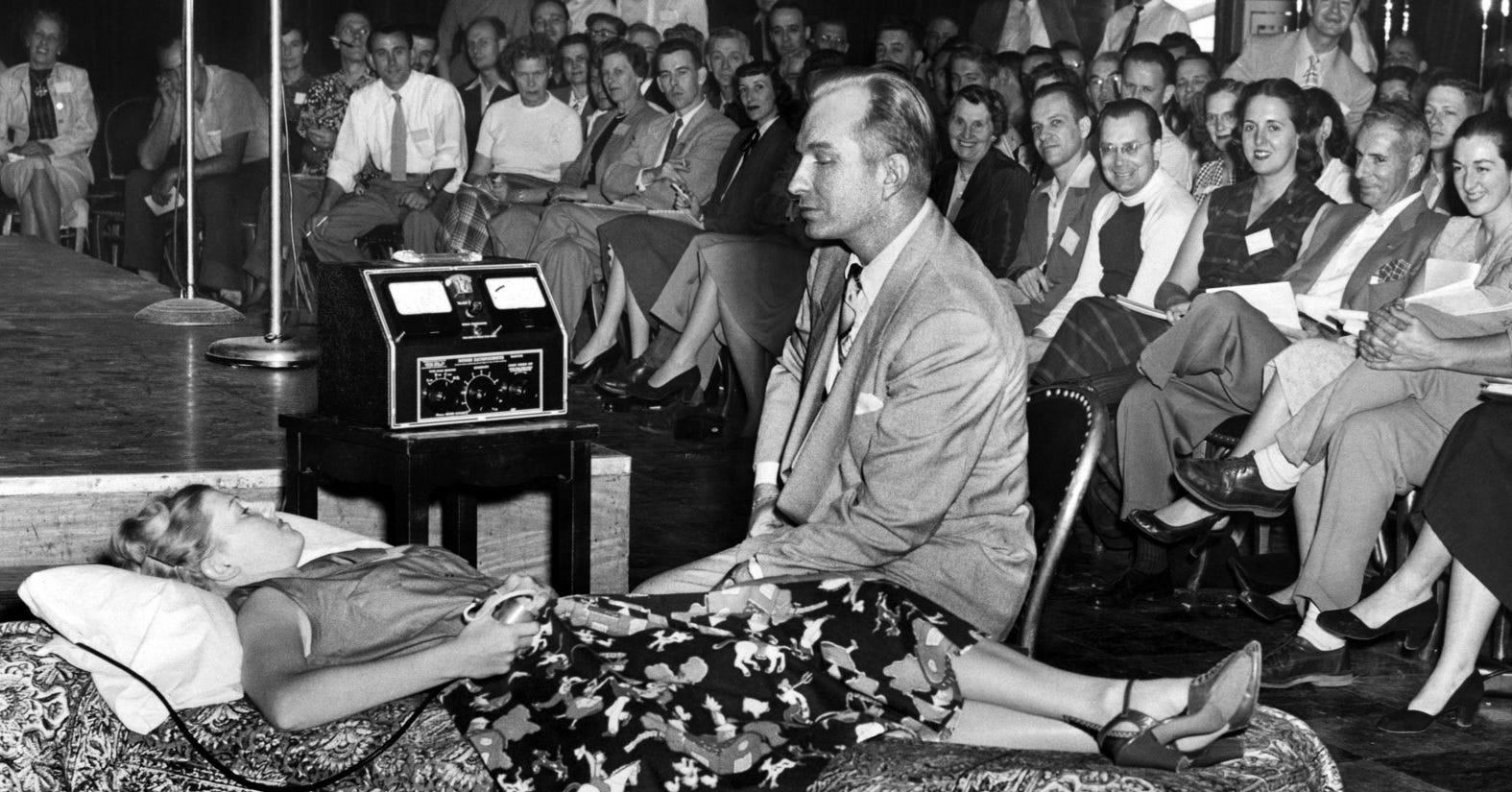
We’ve enjoyed some fun dives into early Scientology history lately, with a look at founder L. Ron Hubbard’s solution for a continuity problem in his cosmology (1952), and the harsh policies he laid down for dealing with perceived enemies (1959).
Our helpers have also been digging up some pretty interesting stuff for us that goes right back to the beginning of things, in the weeks and months after Hubbard first published Dianetics in May 1950 and kicked off this movement.
If you really want to immerse yourself in those days, we highly recommend that you review Russell Miller’s Bare-Faced Messiah, the essential biography of Hubbard that was published in 1987. We were looking at those chapters again recently, and they are just astonishing in their sourcing and the rich material that lays out Hubbard’s movements practically week by week.
But we still do try to add footnotes to the incredible work by Russell, and we have a few things that our helpers have brought us we wanted to share with you.
Our friend who dives into old newspaper archives brought us something rather different this time. Keeping in mind that Hubbard was already a well-known figure to science fiction fandom when Dianetics came out, our helper wondered what kind of an impact the new “science of the mind” had on these devotees of sci-fi. Hubbard and Astounding editor John W. Campbell had previewed Dianetics in the magazine before the book version had come out, and many of the first dianeticists were recruited from these readers of Hubbard’s fiction.
So our friend had a great idea and dug into some old fanzines of the era, and came up with some very interesting things.
Perhaps the best was something in an issue of “Western Star,” a newsletter that was “Edited and published by Jim Kepner at 1534 Grant Avenue, San Francisco...with the assistance of several members of the Golden Gate Futurian Society and the Elves, Gnomes and Little Men’s Science Fiction, Chowder and Marching Society.”

In its fourth number, dated September 10, 1950 (exactly one month after Hubbard’s big coming-out party for Dianetics at the Shrine Auditorium in Los Angeles), Kepner was reporting on a recent weekend convention, NORWESCON, held in Portland.
Kepner’s account gives us a fascinating look at how Dianetics had become such an overwhelming subject in science fiction fandom that summer, which was generating considerable friction at the Portland convention…
Another sore spot of the convention was L. Ron Hubbard’s new miracle mind cure, Dianetics, which Donald Day had once indicated would not be discussed from the floor of the convention. Actually it would have been quite impossible to keep down the one subject that is the hottest thing in fandom, and a warm enough subject even in the mundane world. However, the manner in which the discussion was handled was definitely objectionable. Word had gone out that there would be a pro and con presentation and the room was packed with the regular delegates and over one hundred local dianeticists who showed the most remarkable distemper whenever anyone voiced disapproval of dianetic authority. The cult was out in full force and they barely recognized their position as guests of the NORWESCON. Half the people present claimed to have read the book.
Your editor had previously complained that a speech made by L. Ron Hubbard on Dianetics was chiefly made up of wisecracks. Sunday night we were treated to two more lectures on the subject, both flippant, casual, filled with fancy claims, cute stories, and a paucity of proof. First [Forrest] Ackerman, who told of an original hostility to Dianetics based on a low estimation of Hubbard’s own personality. He told of the early Van Vogt experiments in the “new therapy,” as skepticism had gradually given way to faith. He had little to say that was in any way conclusive as evidence.
When he had finished, breathless [Theodore] Sturgeon took up the cudgel, and announcing that he wasn’t really sold on dianetics yet, he proceeded to lay down the line meanwhile throwing some interesting sidelights of Hubbard himself. When he had finished, there was less than a half hour left for any questions or opposition views. Both Ackerman and Sturgeon managed to be quite cagy about the “stickler” type questions, giving only such answers as “A clear is not a god, merely a superman.”
One interesting revelation was that Hubbard, who claims to have been working on Dianetics for over a decade, spent a greater part of 1947-8 in Los Angeles practicing and preaching hypnotism. This seemed significant in the light of a charge made by one Portland delegate (a professional hypnotist) that Dianetics contained large elements of hypnotism.
What a great account that captures both the undeniable popularity of Hubbard’s claims for a new way of understanding the human mind, but also the pushback that was coming from skeptics who criticized Hubbard’s lack of evidence.
Another example of that pushback was happening at the same time that Kepner put out his fanzine. That same week, the Los Angeles Daily News printed a multi-part series interviewing Hubbard, examining his claims, and publishing some of the harshest early condemnations of it.
It was also the series that produced this wonderful set of photos of Hubbard, a couple of which are very familiar to us.
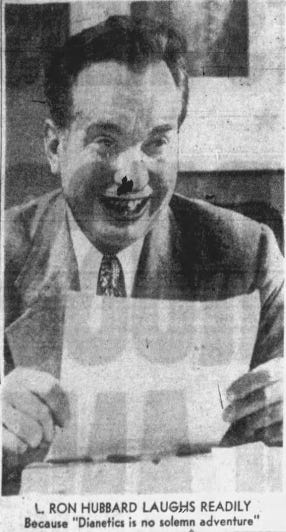
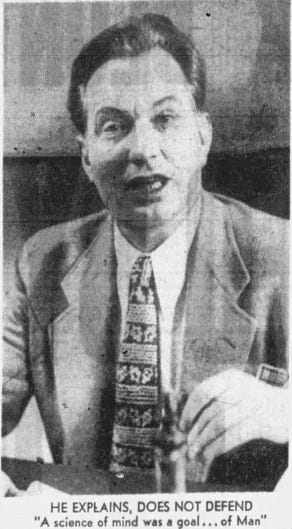
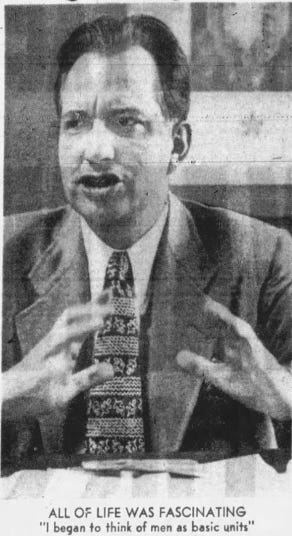
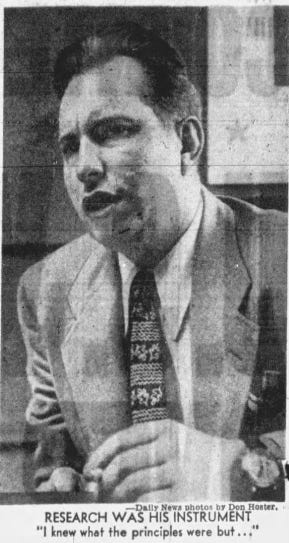
In the final installment of the Daily News series, which came out on September 9, reporter John Clarke suggested that mental health professionals had been holding back their criticisms of Dianetics for one reason or another, but now two of their number — William and Karl Menninger, the brothers of the famous Menninger Clinic in Topeka — were ready to give it both barrels.
Dr. William Menninger, whose very name is to psychiatry what Shakespeare is to literature, served with the rank of brigadier general during World War II as director of the neuropsychiatry consultants division of the office of the surgeon general of the Army.
He is a past president of the American Psychiatric association and the author of such valid volumes as “Psychiatry In a Troubled World.”
He has written and has authorized the use of this damning indictment of Dianetics:
“It can potentially do a great deal of harm. It is obvious that the mathematician-writer has oversimplified the human personality both as to its structure and function and my impression is that he has made inordinate and very exaggerated claims in his results.
“He coins some new terminology and disregards all the psychological theories and observations that have been so extensively studied by so many people.”
Dr. Menninger, it might be noted, is known to his colleagues not only as a scientist of progressive mind but as a man of personal conservatism.
Russell Miller, in Bare-Faced Messiah, also mentions the Menninger Clinic, saying that in December 1950 an article in Look magazine took an especially harsh look at Hubbard and his invention.
The article referred to the ‘awe, fear and deep disgust’ with which the medical profession viewed Dianetics and quoted a doctor at the famous Menninger Clinic in Topeka, Kansas, who conceded that sufferers from mental malaise might find temporary relief from ‘Dianetic hocus pocus’ just as they sometimes do from hypnotism or voodoo. ‘But,’ he added, ‘the greatest harm to a person would come not because of the vicious nature of Dianetic therapy but because it will lead them away from treatment which they may badly need.’
Another researcher messaged us with even more information about why it was that the Menninger brothers in particular had become such vocal critics of Dianetics, telling us that there was an interesting story behind it.
He had dug up some fascinating correspondence in old archives which told the story.
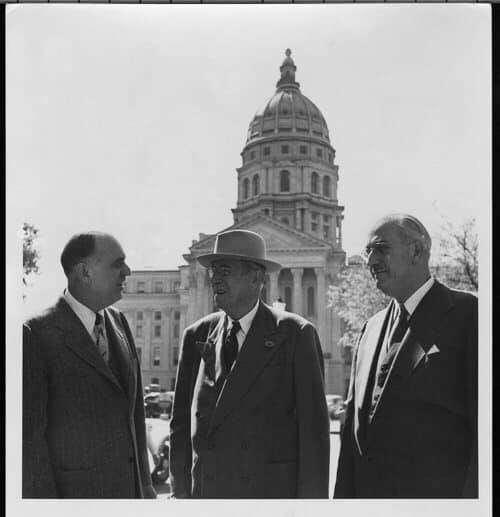
Soon after Dianetics came out in May, its publisher Hermitage House began receiving a large volume of mail from eager readers. One letter was from Dr. Robert Lee Sutherland, director of the Hogg Foundation for Mental Health at the University of Texas in Austin. Sutherland expressed interest in Dianetics, and also mentioned his association with the Menninger Clinic.
As a result, early Dianetic Foundation members began boasting that Dianetics had been endorsed by and was being used at the Menninger Clinic in Topeka. The Menninger brothers discovered this when they started getting applications from people who wanted to get Dianetic auditing from them.
On August 10, Sutherland wrote a memo to William Menninger, apologizing and explaining how this misunderstanding had taken place…
About the first week in July, I wrote a letter to the author of the book via the publishers, telling him of my personal interest and asking if there was anyone who had direct experience with “dianetics” in this area. Unfortunately, in the letter of which I have no copy, I mention my connection with the school. A few weeks later... I again wrote saying that I would be interested in meeting Dr. Winter, their medical front man, in Chicago at the time of my vacation when I had tentative plans for being there.
At the time of writing both of these letters, I had no inkling that this school was in any way to be linked with the practice or teaching of this proposed “therapy.” Now I find that a number of letters of application have been coming to the school... It seems quite likely that my letter, indiscretely worded, may have furthered such a foundless connection. I am writing this memo for your suggestions as to anything I can do to correct the situation.
With the connection between the clinic and Hubbard’s quack “science” already made in the mind of the public, the Menninger brothers realized by early August that there was little they could do but speak out in a way other professionals had not been. And this is why they were so prominently featured in the Daily News series in September, the Look magazine article in December, and in other publications.
The dianeticists weren’t going to take their criticisms lying down, however.
On October 12, Dr. Karl Menninger received a letter from science fiction author A.E. Van Vogt, who was an enthusiastic early adopter of Dianetics, and had been made director of the foundation in Los Angeles by Hubbard.

On October 21st, L. Ron Hubbard, author, Dianetics, will lecture at the Music Hall in Kansas City.
Before that date, I wonder if I might come to your clinic in Topeka, and explain Dianetics to those of your staff who might be interested. I am a personal friend of Hubbard’s and have taken his course in Los Angeles, and am familiar with many aspects of Dianetics not generally known.
There will be absolutely no publicity in connection with such a visit. If no other course is possible, perhaps I might talk at the home of one of the doctors... I want personally to express my admiration for the immense good you have done during your tremendous career.
Two days later, Karl Menninger responded, declining Van Vogt’s offer on the grounds that “I have no evidence that Dianetics has been accepted as a scientific concept or procedure.”
Van Vogt persisted by calling the clinic and asking to speak with Karl, who described the conversation in a memo…
He (Van Vogt) called me on the phone and argued with me for about 15 minutes the other day trying to persuade me to let him come up here and put on a demonstration…I had to get a little rough with him in telling him that I didn’t think it was scientific and we were not interested… he kept insisting that I wasn’t scientific and much annoyed at me but I managed to keep my temper.
Van Vogt then followed up the contentious phone call with yet another letter…
Thank you for talking to me, however forcefully, on Dianetics. Be assured that those who are in Dianetics intend to win the support of men of your standing by operating on the highest possible ethical level. There are perfectly valid reasons why the book was written the way it was. It produced a reasoned and expected result. Why not send someone down to Hubbard’s four lecture-demonstrations, which start in the Little Theater, Municipal Auditorium, on October 25? It may be years before the people of this area will again have the opportunity to observe so skillful an auditor.
With all best wishes for your continued success, and for a long life.
Cordially yours, A E Van Vogt
In November, the clinic made it clear where it stood by including a description of Dianetics in its monthly bulletin.
There is no scientific evidence for any of the theory actually cited, although frequently alluded to, and the theoretical constructs are either naive over-simplifications of psychological principles long-known (and with no credit given to their original delineators), or absurdly humorous attempts to describe the functions of the mind as a “Rube Goldberg machine” with neologistic labeling.
Then came the article in Look magazine as Hubbard’s miracle year of 1950 was drawing to a close, and his nightmare year of 1951 was beginning, which would bring bankruptcies, the very public dissolution of his second marriage, and even his hiding out in Cuba.
But in February 1951, the Dianetic Foundation in Elizabeth, New Jersey made one last effort to sway the Menningers. It was there in Elizabeth where everything had begun for Hubbard and where he had been living when his book came out. The foundation issued a curious challenge to the Menninger Clinic.
Gentlemen:
The Drs. Menninger and other vocal representatives of the psychiatric field have issued such unwarranted and unfounded statements against dianetics, having but scant knowledge of the subject, that in belief of its president L. Ron Hubbard, the Hubbard Dianetic Research Foundation is compelled to submit the following for your earliest possible acceptance:
If two impartial judges will select two neurotic persons, without advice from either psychiatrists or dianeticists, our Foundation will be happy to give them into the hands of psychiatrists for one week, with before and after psychometries of the most rigorous nature. Thereafter our Foundation will give them dianetic processing for one week, with comparative psychometries. If the resultant psychometries prove that dianetics has not done uniformly more for these persons than psychiatry, Mr.Hubbard will be perfectly willing to withdraw his book, “Dianetics,” and admit that dianetics is not better than psychotherapy.
This decisive test is offered in all sincerity by Mr. Hubbard and our Foundation.
Sincerely yours, Charles Leonard Personal Representative
A copy of the challenge was also sent to the American Psychiatric Association.
Menninger didn’t respond, but the APA did:
The proposed test is absurdly inadequate, from the standpoint of the scientific method in general and biostatistical principles in particular. It would be distinctly unfair to a patient, and potentially dangerous, to undertake treatment without proper psychiatric study of the patient to determine the nature of his disorder, his functional status, and the safeguards required in treatment. These are elementary principles of responsibility, well established by medical experience.
And thus ended the brief war between Dianetics and the Menninger Clinic, perhaps the first great battle in the movement’s history.
Hubbard struggled through the chaos of 1951, and then regrouped the following year in Wichita and Phoenix, rebranding his enterprise as “Scientology.”
Van Vogt, still dedicated to the original ideas of Dianetics, wanted nothing to do with Scientology’s focus on past lives and other “mysticism.” He gamely kept the Los Angeles Dianetics operation going through lean times until 1961, and then returned to writing science fiction.
We want to thank both of our researchers for digging up so much good material on those early days.
Want to help?
Please consider joining the Underground Bunker as a paid subscriber. Your $7 a month will go a long way to helping this news project stay independent, and you’ll get access to our special material for subscribers. Or, you can support the Underground Bunker with a Paypal contribution to bunkerfund@tonyortega.org, an account administered by the Bunker’s attorney, Scott Pilutik. And by request, this is our Venmo link, and for Zelle, please use (tonyo94 AT gmail). E-mail tips to tonyo94@gmail.com. Find us at Threads: tony.ortega.1044 and Bluesky: @tonyortega.bsky.social
For the full picture of what’s happening today in the world of Scientology, please join the conversation at tonyortega.org, where we’ve been reporting daily on David Miscavige’s cabal since 2012. There you’ll find additional stories, and our popular regular daily features:
Source Code: Actual things founder L. Ron Hubbard said on this date in history
Avast, Ye Mateys: Snapshots from Scientology’s years at sea
Overheard in the Freezone: Indie Hubbardism, one thought at a time
Past is Prologue: From this week in history at alt.religion.scientology
Random Howdy: Your daily dose of the Captain
Here’s the link for today’s post at tonyortega.org
And whatever you do, subscribe to this Substack so you get our breaking stories and daily features right to your email inbox every morning.
Paid subscribers get access to a special podcast series…
Group Therapy: Our round table of rowdy regulars on the week’s news
This statement from a doctor at the Menninger Clinic is spot on.
“ ‘the greatest harm to a person would come not because of the vicious nature of Dianetic therapy but because it will lead them away from treatment which they may badly need.’”.
IMO this assessment is true of Scientology as well. Hubbards tech took me down many rabbit holes that produced temporary changes leading to my condition worsening. The ultimate product being delusional robotic followers. If Dianetics and Scientology led In the right direction members would get good results and not be dependent on it for more than a short period of time.
Thanks to the researchers and Tony for the excellent article.
I love our volunteer researchers! They go digging in the dirt and produce gems of excellent quality. Is the kerfuffle between the Menningers and Lron the basis for $cientology's disgust with psychiatry? There were many more articles published that whacked Lron's mole in the coming days and years. The psychiatric profession looked at his stuff and pronounced it excrement.
Lron later showed his true colors when he added past lives and implant stations to his minions. Trying to get more goofballs into his fold was his intention in those years. And it worked. By 1959 he was rolling in the dough and bought Saint Hill and tried to live like a British county gentlemen. There was never anything county or gentlemanly in Hubbard's character.