
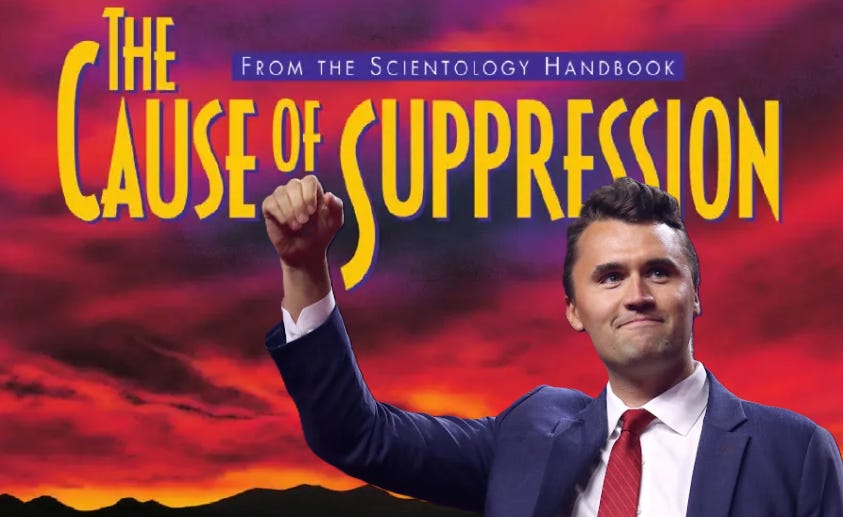
We’re grateful that Joy Villa shared quite a bombshell with us this week.
In regards to a claim by political commentator Candace Owens that one of the “bigger donors” of Charlie Kirk’s Turning Point USA was a Scientologist, Joy told us that she believed Owens was referring to major Scientology donor Craig Jensen.
“I think it’s important to be known that Charlie Kirk — what Candace probably means is one of Charlie’s early big funders was Craig Jensen,” Joy told us. “Craig was heavy into trying to get Charlie into Scientology.”
To back up her assertion, Joy shared with us an email she received from Jensen in 2017. That was the year that Joy’s own notoriety exploded after she wore a “MAGA” dress to the Grammys in February. That November, Jensen was encouraging Joy to get involved with Kirk and his Turning Point USA speaking events.
When Joy asked Jensen if Kirk knew he was a Scientologist, Jensen sent this response…
I was introduced to Charlie by a good friend from Palm Beach. I then put on an event for Charlie at my home in CW and gave him an OSA-escorted tour of the Flag building. He was blown away! I gave him a copy of the “Causes of Suppression” booklet and he said later that it saved his life. So, yes, he knows full well I am a Scientologist and he is supportive.
I am on the Turning Point USA Advisory Board.
Love, Craig
We explained last time that “CW” was a reference to Clearwater, Florida, Scientology’s spiritual headquarters, and the location of the Flag Building, home of the “Super Power Rundown.” And that “OSA” meant the Office of Special Affairs, Scientology’s secret police.
But what did Jensen mean about that booklet that he claimed Kirk said “saved his life?”
Jensen was referring to “The Cause of Suppression,” a short booklet that contains material taken from the writings of Scientology founder L. Ron Hubbard.
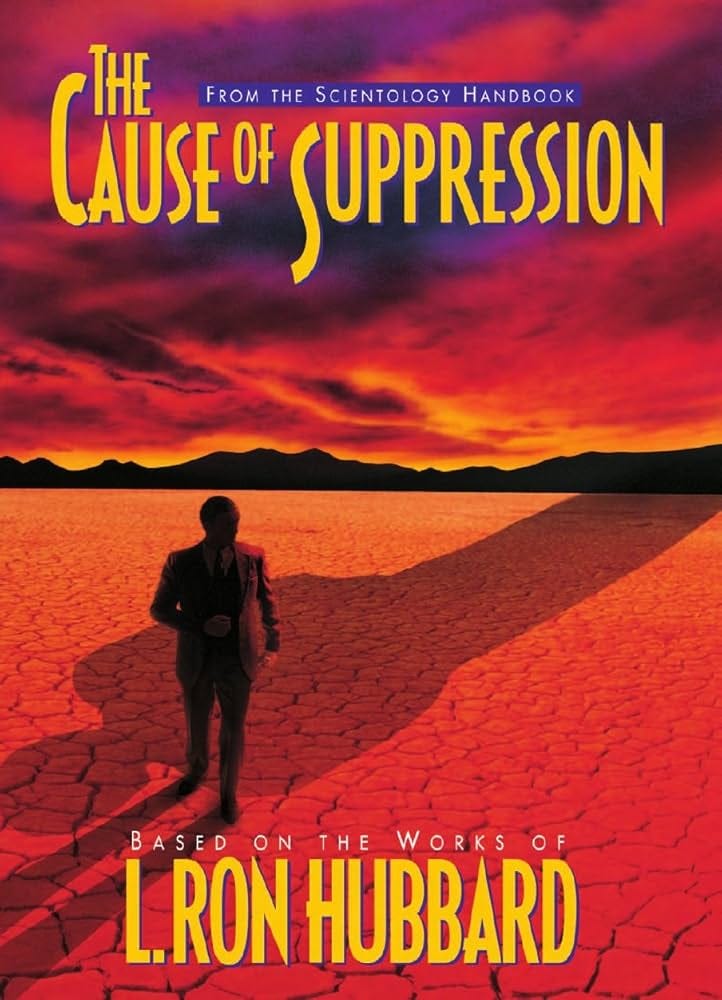

Hubbard claimed in his 1950 book Dianetics: The Modern Science of Mental Health that he was the first person in 50,000 years to understand how the human mind actually worked, and also the first person to discover the meaning of life: To survive.
He explained that things which tended to undercut your ability to survive was what he called “suppression.” Other people, for example, could be “suppressive” if they held you back from your full potential.
In this 42-page booklet, Hubbard said that a major source of suppression is the “anti-social personality.”
These are bad people, which he said make up about 20 percent of the population, with about 2.5 percent being “truly dangerous.”
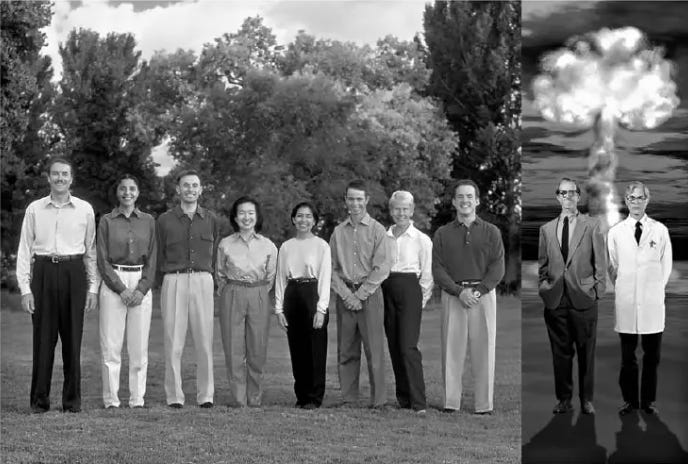
[Actual caption: “A relatively small proportion of a race, about 20 percent, possess antisocial characteristics. They cause trouble for the remaining 80 percent out of proportion to their number.”]
We’d all be a lot better off, Hubbard said, if we could identify these rotten 20 percenters and then find a way to “handle” them.
To help recognize antisocials, Hubbard described their twelve attributes, briefly summarized here…
1. He or she speaks only in broad generalities. 2. Such a person deals mainly in bad news. 3. The antisocial alters, to worsen, communication. 4. An antisocial does not respond to treatment. 5. Surrounding an antisocial we find cowed or ill associates that make trouble for others. 6. The antisocial habitually selects the wrong target. 7. The antisocial cannot finish a cycle of action. 8. Antisocials freely confess to crimes with no sense of responsibility for them. 9. The antisocial supports only destructive groups, and (10.) fights against helpful actions. 11. Helping others drives an antisocial berserk. 12. The antisocial has a bad sense of property.
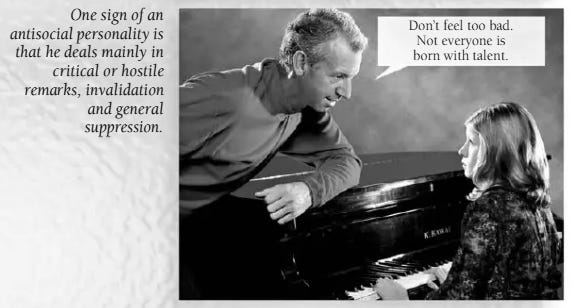
“The basic reason the antisocial personality behaves as he or she does lies in a hidden terror of others,” Hubbard said. “To such a person every other being is an enemy, an enemy to be covertly or overtly destroyed.”
Hubbard then described the “social personality,” which has twelve attributes that are essentially mirror opposites of the antisocial personality.
“The social personality wants to survive and wants others to survive, whereas the antisocial personality really and covertly wants others to succumb.”
Hubbard then explained that another way to describe an antisocial personality is to call them a “Suppressive Person” or SP. And someone who is connected to an SP, and is negatively influenced by their suppression, is called a “Potential Trouble Source,” or PTS.
The person who is PTS, who is being influenced by an evil SP, may manifest that influence by becoming ill.
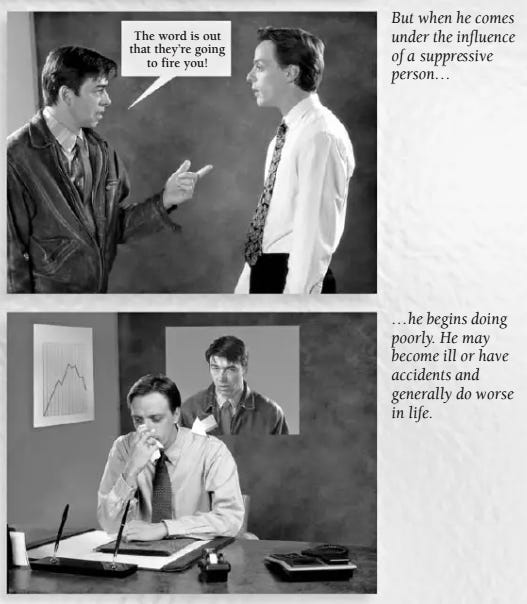
“A potential trouble source is doing well and then not doing well, doing well, not doing well. When he is not doing well, he is sometimes ill.”
Hubbard further broke down the person who is PTS into three types.
PTS Type I is a person who is connected directly to an SP, such as a family member, for example, who is negatively influencing them.
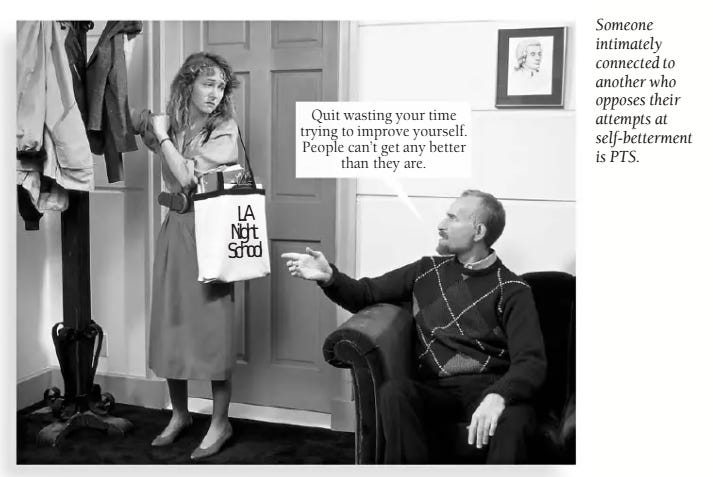
A PTS Type II person is reacting in the present to something that negatively influenced them in the past. Something they see today may trigger that memory of previous suppression.
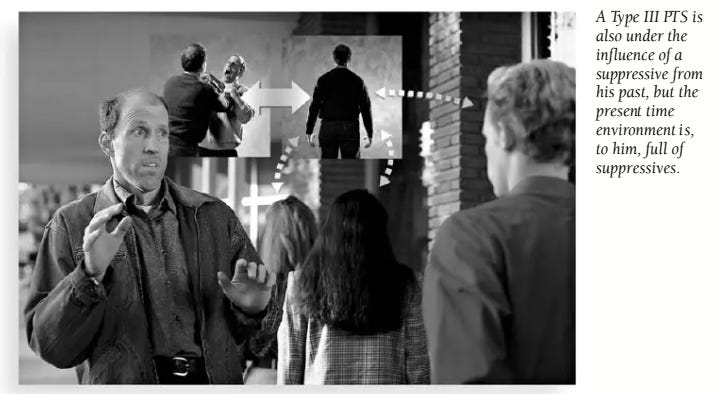
A PTS Type III person is being negatively influenced by everyone and everything, and even things that don’t exist. “The Type III PTS is mostly found in mental institutions,” Hubbard said, and in Scientology, “Type III” is generally shorthand for “insane.”
So with all of these sources of “suppression” in the world, how does the sane person deal with it?
Hubbard offered a three-part solution: Discover, Handle, or Disconnect.
Using Hubbard’s counseling techniques, called “auditing,” a person who is PTS is asked to recall how they first fell ill in order to identify where the suppression came into their lives, and who is responsible. In other words, to find the SP that is influencing them.
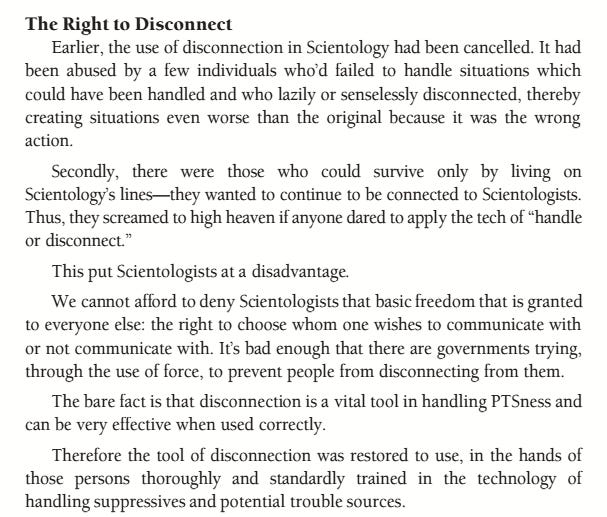
Once that source of the problem is identified, then the person can either “handle” them — change the nature of their relationship, for example — or they can cut off all contact with that person and “disconnect” from them.
Former Scientology spokesman Tommy Davis will forever be known for telling John Roberts in a live CNN segment that there is no disconnection in Scientology, but here it is, all spelled out in the booklet…
What Scientology is less forthcoming about is that disconnection is used as political leverage in the church, and the result is the ripping apart of families.
Are your parents expressing doubts about you continuing in Scientology? They’re suppressives, so disconnect from them and cut off all communication.
It’s one of the things Scientology is most well known for, this toxic policy of cutting off doubters and critics, and it’s where this booklet ends up.
Charlie Kirk was assassinated in September, so we can’t ask him what part of this booklet “saved his life,” as Craig Jensen claimed in his 2017 email to Joy Villa.
But perhaps Jensen will have an opportunity to expound on that at some point.
What part of this booklet did Charlie Kirk find so useful? What do you think?
Mark your calendars

Our Group Therapy listeners heard it first as we announced the big news: Patty Moher, Alex Barnes-Ross, and Phil Jones are organizing the return of HowdyCon!
It will take place from September 18-20 in New London, Connecticut, and we have a website. Go on by and register your interest.
News about speakers and other developments will go out first on our Group Therapy podcast, so please sign up as a subscriber if you haven’t already!
Want to help?
Please consider joining the Underground Bunker as a paid subscriber. Your $7 a month will go a long way to helping this news project stay independent, and you’ll get access to our special podcast series…
Group Therapy: Our round table of rowdy regulars discussing the week’s news, which drops each Sunday at noon.
Also, you can support the Underground Bunker with a Paypal contribution to bunkerfund@tonyortega.org, an account administered by the Bunker’s attorney, Scott Pilutik. And by request, this is our Venmo link, and for Zelle, please use (tonyo94 AT gmail). E-mail tips to tonyo94@gmail.com. Find us at Threads: tony.ortega.1044 and Bluesky: @tonyortega.bsky.social
For the full picture of what’s happening today in the world of Scientology, please join the conversation at tonyortega.org, where we’ve been reporting daily on David Miscavige’s cabal since 2012. There you’ll find additional stories, and our popular regular daily features:
Source Code: Actual things founder L. Ron Hubbard said on this date in history
Avast, Ye Mateys: Snapshots from Scientology’s years at sea
Overheard in the Freezone: Indie Hubbardism, one thought at a time
Past is Prologue: From this week in history at alt.religion.scientology
Random Howdy: Your daily dose of the Captain
Here’s the link for today’s post at tonyortega.org
And whatever you do, subscribe to this Substack so you get our breaking stories and daily features right to your email inbox every morning.
I don't know, just because Hubbard stole an idea doesn't make it false. There are times when the only way to recover from an abusive relationship is to end it.
Where Scientology goes off the rails is to assign the label "suppressive" to anyone who doesn't like Scientology. One of these things is not like the other.
We need to ask Janice Grady if she recognizes the faces in the truly awful illustrations. They have the stink of Hubbard about them.
Hubbard stole some interesting material in his time. Unfortunately, he added his own spin on it. In doing so, it made it impossible to separate the good from the bad. Some of what he said had good in it, bur the fanatical application of any principle is where things go bad.
Whatever it was that Charlie saw in this booklet escapes me. All I see is over the top Hubbard blather. He makes some good points, I guess. But he had fanatical followers. And when fanatics read things someone writes, it is not necessary for the author to speak the truth. He can express an idea then expand on it in a way that has everyone reaching for their pitchforks.
Hubbard created a group of people who decided that anyone who didn’t believe exactly as they did were bad. They still think that. Rather than listening to opposing views, they close their minds. This is dangerous for themselves and others. But an easy way to create a closed society.