The transcript: Read along as judge denies Scientology doc's legal ploy

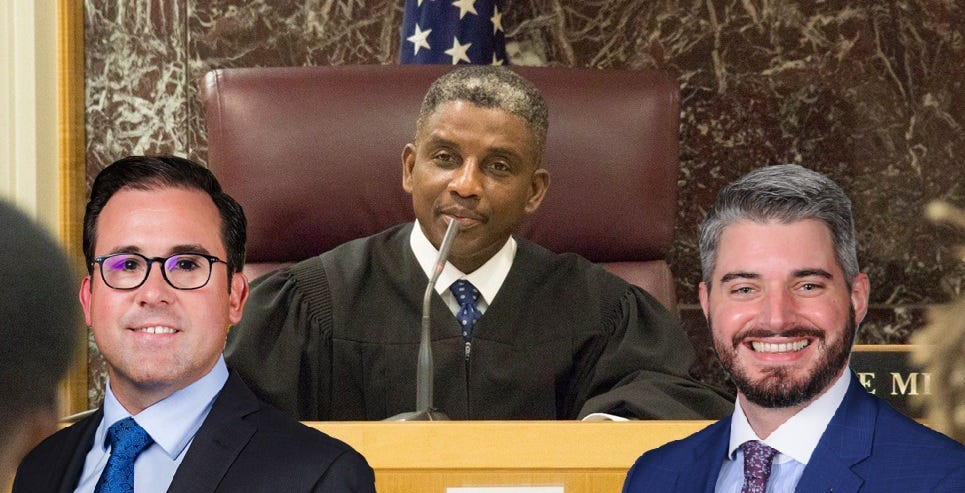
Earlier this month we were fortunate enough to get help from Mark Bunker, who attended an April 1 hearing in Clearwater, Florida in the Whitney Mills wrongful death lawsuit.
Whitney was an OT 8 Scientologist who suffered from extreme mental distress but, the lawsuit alleges, she was discouraged from getting proper mental health care and was instead encouraged by her Scientologist handlers to end her life, which she did in May 2022.
If you remember, in the hearing Kyle Fontaine, lawyer for Dr. David Minkoff, the notorious Scientologist medico who treated Whitney and who at one time lost his license in the Lisa McPherson tragedy, was arguing that his client should be dropped from the suit for deficiencies in the “pre-suit” period of the case. Specifically, he was arguing that the plaintiff (Whitney’s mother Leila Mills) had consulted experts who were not “alternative” medicine practitioners like Minkoff.
Bunker told us that Ms. Mills’ attorney, Ramon Rasco, countered that the experts he’d hired were appropriate for the actual things Minkoff did in Whitney’s case, and Judge Michael Andrews agreed.
Now, we’ve noticed that Rasco filed the actual transcript from that one-hour hearing in the court docket, and we think it’s fascinating to see Judge Andrews question Fontaine about alternative medicine. We thought you’d want to see it too. It’s long, but we think it reads pretty quickly for a legal hearing.
The only people speaking were Judge Andrews, Ramon Rasco for Ms. Mills (on Zoom), and Kyle Fontaine for Dr. Minkoff.
But also either in the judge’s chambers or on the phone were: Katherine Ranero (for Minkoff), Joshua Truppman (for Ms. Mills), Charles M. Harris Jr. (for the Scientology defendants), and Niza Russell (paralegal with Rasco).
OK, let us know what you found interesting or surprising…
Kyle Fontaine: Your Honor, I guess the easiest way to do this is sort of start with an overview of the case. This is a — you can probably tell if you reviewed the complaint or some of the docket materials, there’s sort of two components to this lawsuit overall. The component we’re here on today is the medical negligence action filed by the plaintiff against Dr. Minkoff and Lifeworks.
The case in general involves care and treatment rendered in Dr. Minkoff’s office in January of ‘22 through April of ‘22. The decedent Leila Mills — I’m sorry, Whitney Mills, she took her own life in mid-May of 2022 after Dr. Minkoff had discharged her for not following his medical advice a few weeks prior, April 27th. We’re here today on my motion to determine the sufficiency of pre-suit and there’s two components to it, which, of course, I’m going to go through, Your Honor. But just a little bit more on the medicine in the case because really what we’re talking about is an alternative or complementary care clinic.
Your Honor’s probably familiar with that trend, particularly in recent years but also going back over a decade that began sort of with some of the cancer treatment initiatives in the state of Florida I filed along with in this package here, Your Honor. For example, the Patient Bill of Rights and the right to alternative or complementary healthcare statutes that were passed back then as a part of that process in which Florida — the Florida legislature recognized the right of patients to seek out alternative or complementary healthcare.
This case does not involve cancer but just that was sort of the initiation of patients who didn’t want chemo or wanted to pursue different means of treatment, and that is certainly something that the legislature said patients have a right to do and providers have a right to provide. Like I sort of had mentioned, Miss Mills originally came in to this clinic — she’d actually been at the clinic in years past for various ailments and different types of alternative treatments that she’d been seeking. A couple times I think in 2015, 2017, maybe 2020. But the case for our purposes begins in January of ‘22.
Judge Andrews: Is Dr. Minkoff the owner of this clinic?
Fontaine: It’s his clinic, yes, and the basic allegation for him is a claim of medical negligence against him and then the allegation against his clinic is that it’s vicariously liable for his care. I'm not here to dispute that today. That’s not what the motion’s about. And in addition I believe there’s vicarious allegations against his nurse-practitioner named Sue Morgan. She’s not sued individually but there’s allegations the clinic’s vicarious for her.
This patient, like I said, came in in January of ‘22 and she started a number of alternative or complementary care treatments at Lifeworks. Things like hyperbaric oxygen therapy, vitamins and mineral supplementation, various IV infusions, ozone therapies. Those are the kinds of treatments that were provided at this clinic. Dr. Minkoff personally first saw this patient Miss Mills February 22nd of ‘22. In his note he said basically that Miss Mills, her history, she had a UTI. She was treated with some antibiotics called Cipro in August of ‘21 and ever since then the patient, Miss Mills, was reporting various symptoms like insomnia, anxiety, heart rate increase, head pressure, head pain, a weight loss of 10 pounds, things like that.
She’d been seen by chiropractor and other providers, and frankly, Your Honor, part of the issues that brings us here today, we really don't know the extent of the other providers she was seeing because of some of the discovery issues that I’m going to get into in the pre-suit period. One of the things that I think is worth noting is Dr. Minkoff in his initial physical exam, he found a pelvic mass which he even thinks to sort of work-up and that included referrals for non-alternative treatment, meaning mainstream or conventional medical treatment. Things like a CT Scan a PET Scan, which were done at a local facility.
The PET Scan, the CT Scan, you know, those things showed, for example, an ovarian mass that was likely or likely to be malignant according to the records from Akumin Radiology. So he referred her, for example, to a GYN surgeon who ultimately recommended removal or a hysterectomy, I believe. It’s a little unclear which to me of this ovarian mass that was presumed malignant, you know. After that surgery was cancelled or not done, Dr. Minkoff ultimately discharged her, the patient, because he told her, I need you to go through with this and get this malignancy dealt with. About three weeks later Miss Mills took her own life.
Let’s see. As a part of the intake process at Lifeworks, the patient, Miss Mills, signed a number of consent agreements which are important today because consent agreements are contractual agreements. So there’s a little bit of a contractual issue today. Like I mentioned, his last — Dr. Minkoff’s last office appointment, which he had contact her in person communication with Miss Mills, was April 20, ‘22. He discharged her, like I said, for not following his recommendations on April 27th and then she passed away on May 13th having attempted or having successfully taken her own life the day prior, May 12th.
One of the primary things that Dr. Minkoff was treating, which you’ll see is all over the complaint, the amended complaint, one of the primary things he was treating her for was Lyme disease. He believed she had a chronic form of Lyme disease for which he was treating her. In addition to some of the other things that are referenced in his medical records. The overall allegations here to me they’re a bit nebulous or vague. That’s a subject of a different motion entirely. But I guess I would say it boils down to two things. One, Dr. Minkoff misdiagnosed her ovarian cyst as malignant and that as a result it made Miss Mills anxious or depressed enough to take her own life.
That’s one of the allegations, which obviously we’re not here to talk about the merits of the case, but considering all of the imaging, I think that we’ll get there one day potentially. Second allegation would be a failure to refer Miss Mills to a psychiatric provider to screen her for suicide risk. Those are the two basic allegations from what I can distill from reading this 100-something page complaint. Again, similar claims asserted against Sue Morgan, his nurse-practitioner and vicarious the clinic. So we’re here to talk about the pre-suit process, Your Honor. As I’m sure the Court is familiar, there is a medical screening process in Chapter 766. It requires a number of things.
It requires that an appropriately qualified expert be retained, review the records, send over a notice of intent that the expert has to have some sort of verified medical opinion. Traditionally it’s an affidavit that delineates some form of criticism and causation, and then that kicks off this 90-day screening period in which the defense does the same thing. We hire experts, we get records. There’s rules for discovery. And in this case, unfortunately, there's two problems with pre-suit period and it’s not optional. This is completely mandatory and any failure can give rise to dismissal, especially if it relates to the type of expert. That’s going to be clear on some of the case law that we’ll go through.
There’s two things here. The plaintiff retained a neurologist, a psychologist and an infectious disease Board Certified physician. OK. These are three — the neurologist, I don’t believe there’s going to be any argument that a neurologist is qualified to have a standard of care opinion about Dr. Minkoff. I don’t think there’s going to be any doubt that neither does a psychologist who’s not even a healthcare provider under the Medical Malpractice Act.
I think the plaintiff’s theory that we’ll hear today is that an infectious disease expert who’s Board Certified in infectious disease is so qualified. However, Dr. Minkoff is not an infectious disease specialist. He is an alternative or complementary healthcare provider. That’s what he offers at his office. There has been no effort by the plaintiff to obtain a qualified expert who has any experience in alternative or complementary healthcare or who is an alternative or complementary healthcare provider.
You can be integrated medicine, alternative medicine, I think people use the phrase holistic as well. These are all sort of synonymous for this concept recognized under Florida law. So that’s issue Number one. That of its own is sufficient for this Court to render a dismissal. If the Court can determine on the four corners of the complaint that the statute of limitations has passed and its with prejudice —
Judge Andrews: When did she pass? What year was it? 2022? And what’s the statute of limitations?
Fontaine: So there’s a two year statute of limitations, it’s usually a factual incree in a medical malpractice case. I'm not going to argue today that you can make that determination because I think further briefing would need to be done for the Court. Although there is a separate statute of limitations for wrongful death cases which is two years from the date of the death, which we are long past. And there’s a statute of repose which is four years which we’ve not met yet.
Judge Andrews: OK.
Fontaine: There are other sanctions of course but dismissal is chief or paramount of those. And then the second issue we're here is also a pre-suit issue and it involves discovery. We have two main issues that I’m going to cover in that. One is basically what I would call for the Court liability pertinent discovery. The biggest thing is a complete failure to respond to a supplemental request to produce for various telephonic information, telecommunication information.
Your Honor will note from the complaint that almost all of the allegations that relate to how Miss Mills’ mental state was during the period of time that Dr. Minkoff was her treating physician, are based on text messages exchanged either between the decedent and various members of the Church of Scientology or Dr. Minkoff. One thing that is absolutely missing from this case are all of these text messages with the plaintiff which includes her mother and the decedent. And I’ll get into why that's really pretty crucial but these discovery responses need to be responded to and weren’t.
There’s some other items in there, things about statements or photos or little things that are objected to. But when you look at the totality of the objections in the pre-suit period, they mirror cases in which the Court ordered dismissal and an appellate court affirmed dismissal because of the failure to complete or comply with pre-suit discovery. As a related but second issue, Your Honor, just to give you the last bit of the roadmap. There’s some financial discovery information which we explicitly extended the pre-suit period to enable the plaintiff to provide and we have never received it. It should have been provided.
These are things like — basically that go to a net accumulations claim. Now I understand if the Court is not inclined to grant a dismissal for the various other reasons, that the Court does have the ability to award lesser sanctions. I don’t think they’re appropriate for the other issues, in fact, I think you can’t do anything else but dismiss the case for the expert issue. But, for example, the financial discovery. One option could be strike the net accumulations claim for noncompliance with discovery is the basic — is sort of I think, the least invasive possibility for a sanction. If Your Honor’s OK with it, I'm going to go basically to the pre-suit rules on experts and I'll use the binder to do that so we can look at the stuff.
Judge Andrews: OK.
Fontaine: Your Honor, if you go to Tab 19. That's the Duffy case. I will read the cite for our court reporter. This is probably the —
Judge Andrews: What are the pre-suit rules, 766, right?
Fontaine: Yeah.
Judge Andrews: What part of that rule are you traveling on at this moment?
Fontaine: Sure. I was going to give the overall how we conduct a proceeding on pre-suit. But just to answer Your Honor's question, the same expert specialty rule is Tab 7, and that's Section 766.1025. So if you go to Tab 7, you'll see that rule there. If you go to page 2 of the Westlaw print page, you have Subsection 5 and this is what it says. “A person may not give expert testimony concerning the prevailing professional standard of care unless the person is a healthcare provider who holds an active and valid license and conducts a complete review of the pertinent medical records and meets the following criteria.”
[There’s some discussion about page numbers to get on the same issue.]
Fontaine: So this has been incorporated — this is the general rule in med mal for expert witnesses. But one of the other pre-suit statutes, I think it's 202, incorporates this. That's not going to be in dispute, this is explicitly referred to as the… So there's three options. If the defendant is a specialist, OK, that's Subsection A. You'll see that’s written there. If the healthcare provider against whom the testimony is offered is a specialist, then the expert witness must, one, specialize in the same specialty. Or they have to teach that same specialty or they have to be in a licensed teaching institution — I'm sorry, a research institution in that exact specialty. Basically we all would say it’s the same specialty rule.
The second option is Subsection B. And that's if it’s a GP, a general practitioner, think your family practice provider out there. There’s no GP expert in this case. But either way, that’s if you have a general. Then you have to be a generalist but it’s actually within five years. And then there’s an option that says if it’s neither, if it’s other than a specialist and a general practitioner, and this is Subsection C at the top of page 3, then they have to be involved in the active clinical practice of or consulting with respect to the same or similar health profession as the healthcare provider.
Our position, Your Honor, is that Dr. Minkoff is a specialist. He is a practitioner of alternative or complementary healthcare. That’s what he does for a living. That’s what he’s been doing for 20 years. He’s a rather renowned figure in that community and in the local community, especially as it relates to the provision of alternative or complementary healthcare. He’s clearly not a general practitioner. There’s no general practitioner expert in this case. There’s no family practice guy or just general internist out there in a primary care clinic. The other option is that the Court could not find that he’s neither. I disagree with that but even if you find he’s neither, there is no expert in this case who has the active clinical practice of or consulting with respect to the same or similar health profession.
No expert retained by the plaintiff works in the field of alternative or complementary healthcare. It’s a hospital consultant who has an outpatient clinic in infectious disease, that’s a very highly specialized career. It’s a neurologist that has no — frankly I don’t think there’s going to be an argument on the other side, has nothing to do with standard of care of a physician like Dr. Minkoff.
Judge Andrews: What is alternative healthcare? What I mean by that is, it seems to me it’s more than any one thing. Alternative healthcare, is it defined somewhere where we can go and say that this is alternative healthcare?
Fontaine: Yeah, we have a statute on that which is going to be your tab — Tab 11, should be your Tab 11.
Judge Andrews: Complementary or alternative healthcare.
Fontaine: Yes, exactly.
Judge Andrews: And where is it defined in here?
Fontaine: Definition Section 2A, Complementary or alternative healthcare treatment means any treatment that is designed to provide patients with an effective option to the prevailing — an option to the prevailing or conventional treatment methods associated with the services provided by a healthcare practitioner. Such a treatment may be provided in addition or in place of other treatment options. Now I think a lot of —
Judge Andrews: Let me ask this.
Fontaine: Yes, Your Honor.
Judge Andrews: So complementary and alternative healthcare means any treatment, meaning any treatment, that is designed to provide patients with an effective option to prevailing conventional treatment?
Fontaine: Correct.
Judge Andrews: All right. I’m not sure I understand what that means. I mean, “any treatment which is an option.” Is it defined somewhere what any means? Is there a narrowing of what any actually means anywhere?
Fontaine: Your Honor, you're not going to find it in this statutory definition of what any means. This is the complete definition that the legislature has given us.
Judge Andrews: OK.
Fontaine: I do want to just point out it’s any treatment that is designed to be an effective option to the prevailing or conventional treatment methodologies. So, for example, just as a silly example, not a silly but an example, not in this case because it all came out of cancer treatments. Instead of chemo, it would be, are there effective options instead of chemo that these providers can provide. If you go to an oncologist, they’ll be recommending chemo or radiation therapy. You go to an alternative care practice facility, it’s going to be something other than that.
Judge Andrews: And what the something is, is my issue.
Fontaine: I understand. But you’re raising — I think, Your Honor, you’re raising a point that I think helps my argument.
Judge Andrews: We’re more than a half hour into our one-hour hearing.
Fontaine: All right. Your Honor, just to tie a bow on that. The point is that there’s nobody who stands in a similar position in this case who has reviewed the care for the plaintiff of Dr. Minkoff. Nobody that does any sort of complementary or alternative healthcare. And that is required under whether you find it’s a specialty or you find that it’s something else. If we’re going to look at other options that people look at are things like Board Certifications. Dr. Minkoff is Board Certified in pediatrics but hasn’t practiced in pediatrics for many, many years. There’s no Board Certified pediatrician on the other side.
Judge Andrews: That wouldn’t apply anyway, right?
Fontaine: I don’t think it would. That’s why I say it’s not just about the Board Certifications, it’s about the actual practice components. And what I provided for the Court in this hearing binder and the file motion are Dr. Minkoff's CV, his website profile, his web page from his practice that kind of delineates the types of treatments that he provides.
Judge Andrews: In substance what you’re telling me is that any expert that they provide is not going to be a complementary expert and therefore they don’t meet the standard of the statute?
Fontaine: I think that’s pretty simply put, yes, Your Honor.
Judge Andrews: All right. Is there anything else you need to tell me or let them respond at this point?
Fontaine: I’d like to go to the discovery stuff, if I can, Your Honor.
Judge Andrews: Do that now. They have to have an opportunity to respond.
Fontaine: OK. I got started at about ten after, fifteen after.
Judge Andrews: I understand.
Fontaine: I don't want to push your — try your patience. I tried to get as much time as I could here. I'll put this in the most succinct way that I can, Your Honor. If you could turn to the Dressler case — and for the record I never cited the Duffy case, 614 So.2d 539. But if you can turn, Your Honor to the Dressler case because there's a page here I think is very helpful. That is Tab 22, the Dressler versus Boca Raton Community Hospital, 566 2 So.2d 571.
This is an opinion about some discovery failures that led to the dismissal and affirmance of dismissal of a case. I'd like you to go to page 2 of the opinion and here's an enumerated list of the examples that the Court cited, in fact the appellate court cited, as sustaining the dismissal, for failure — this is without prejudice being proven by the defendant, for a failure to comply with the reasonable rules in pre-suit discovery.
Question Number three it says, “A brief statement outlining the way Boca Raton Community Hospital deviated from the standard of care.” Five is a list of healthcare providers. In the last — it just says over the past ten years. I think it’s our standard Supreme Court prove interrogatory. Six, copies of records. Eight, the names and addresses of insurance carriers responsible for the payment of medical bills.
Each one of these were objected to, and in our case almost the exact same questions were objected to. Exhibit J to my motion, questions one through three ask for the theory of liability against my clients in pre-suit; objection, refer to the notice of intent Number five, I asked for a list of healthcare providers that the patient or decedent had seen in the last ten years. Exhibit J, question Number four, objection, overly broad and burdensome.
Judge Andrews: But what am I listening to today? The only motion I’m addressing is whether or not the pre-suit is accurate at this point, right?
Fontaine: Because this is part of pre-suit discovery. I’m telling the Court, and having filed this, that they’re pre-suit — the pre-suit screening that they conducted was also insufficient, which is also a basis for dismissal because they failed to provide us with information that the statute requires they provide us with. Not only financial information but past healthcare providers, photos, and the most important thing is text messages, Your Honor. Again, you look at the complaint, there’s like 30 screenshots of text messages, the complaint is the foundation of their case for why Dr. Minkoff should have referred this patient to a psych provider, OK.
And they said that the decedent Miss Mills, Whitney Mills — I’m sorry, Leila Mills, who is the mother who is the personal rep, she was living with the decedent. They told us that she engaged in text messaging some form or fashion almost every day with the decedent. We asked for all of their text messages from 2022 because that would cover the three months or four months that she was a patient of Dr. Minkoff where they're getting all these text messages from and they only provided I think like four pages of a one week’s worth.
I then served a supplemental discovery request, Your Honor, to ask them what type of phone did she have, do you still have it? Who’s the carrier? Like what other forms of communication, written communication did they have? Because I don't want to be surprised when I find out there’s all these text messages that they’re going to use as a part of their liability case against my client. I need them.
Judge Andrews: Do you need the type of phone to know the text messages?
Fontaine: Well, I didn’t get the text messages.
Judge Andrews: Answer my question. Do you need to know the type of phone to get the text messages? Do you need to know the carrier?
Fontaine: Well, I need the carrier, I need the number.
Judge Andrews: Why do you need the carrier?
Fontaine: So I can go get the billing statements to show where the text messages are going to and from.
Judge Andrews: The billing statement will show the text messages?
Fontaine: It’ll show text messages to and from, yes. It may not show the text of it though but at least to be able to say, hey — I mean, what if I have spoliation motion, Your Honor. I need to know that there were text messages exchanged about her mental status.
Judge Andrews: Well, I hear you, but I’m not so sure that that fits so much in the pre-suit. Anything else before I let them respond?
Fontaine: No, you can let them respond, Your Honor. I'll save the rest —
Judge Andrews: All right. Who’s going to be responding and what is the response?
Ramon Rasco: Yes, Your Honor, Ray Rasco again on behalf of the plaintiff.
Judge Andrews: Yeah, I’m having trouble hearing you and the court reporter’s having trouble hearing you also. Hold on.
Rasco: Can you hear me better now?
Judge Andrews: Yes.
Rasco: Great. Your Honor, I want to first thank you for letting me appear by Zoom. My wife is very sick and I have to take my son to and from school today and so I have to be at noon — I think we can dispense with everything by then, if you just give me less than ten minutes. I’ll start where he ended, which is on the pre-suit discovery which I’m not going to spend too much time on. But we provided six sets of discovery responses during the pre-suit period including three sets of interrogatories and three sets of request for production totaling 1,337 pages of documents.
In addition to that, we provided the unsworn statement of Leila Mills, personal representative of the estate, where she spent about three hours crying answering questions and the unsworn statement of Dr. Minkoff for about two hours. We also provided them eleven authorizations during that time period including the Form 4506 for her tax returns, which we didn’t have ourselves. A Wells Fargo authorization, multiple healthcare authorizations an added authorization to obtain earning status from the Social Security Administration.
Safe to say that we spent a lot of time responding to all of the requests. We also provided multiple text messages included in the complaint and discovery responses. Missing information for the January to May 2022 period, we can address that. We're confident that we can do that.
Judge Andrews: One thing you said you can address it. The question is whether you refuse to address it, I think that's what I was being told. I think the response was something like overbroad and all those typical responses we sometimes get.
Rasco: Sure. We did the objections but we also provided an answer. So it would be the objection, it was overbroad but here are the text messages that we have between Leila and her daughter for those four or five months of 2022.
Judge Andrews: So even though you objected you did provide it?
Rasco: That’s correct and I can give you the Bates numbers, Your Honor
Fontaine: No.
Rasco: So we have that and we provided that. If there's something that's missing —
Judge Andrews: Well, I think I hear you saying you’re not objecting to providing an answer at this moment even if it turns out you haven't provided it.
Rasco: No, we’re not in the least bit objecting. We filed objections, we can remove those and we can answer if necessary. But we have provided text messages and — we provided those in the complaint as well as in the production during the presuit discovery. So that's all I have on that.
The Dressler case, that was through dismissal entered there but the reason why was because the response consisted of only basic personal data on the plaintiff, consisting of her name address, date of birth and social security number, as well as a list of the healthcare providers. That was all that was provided. This is not what we’ve done here, Your Honor. In addition, since the suit has been filed, we’ve sent discovery third-party subpoenas to the persons who would have financial data for her and the authorizations that we provided to Mr. Fontaine. So, that’s that.
As far as the pre-suit requirements for experts in the same specialty. He’s traveling under 766.102(5), if a person is a specialist and Dr. Minkoff may bill himself as a specialist or an expert in alternative or complementary medicine, and they’re different. And when we took his unsworn statement he made that distinction is that I prefer complementary or integrative medicine. Meaning that it’s in addition to not as an alternative to. In other words, it’s not a homeopathic medicine instead of chemo therapy, it’s in addition to the medical treatment that he thinks is appropriate.
So that statute says specialist, right, but Florida Statute — Florida Statute 458.3312 defines specialties and specialist. It says, “A physician licensed under this chapter may not hold himself or herself out as a Board Certified specialist unless the physician has received formal recognition as a specialist from a specialty board of the American Board of Medical Specialties or any other agency that has been approved by the American Board of Medical Specialties.”
The American Board of Medical Specialties does not recognize, does not provide board certification for alternative, complementary, or integrative medicine. There's no such thing in the state of Florida as a board certification for that. If there was, Dr. Minkoff would not have it. He has a board certification from somebody else for ozone therapy treatment. We’re not arguing that he did anything wrong or that he did anything wrong with respect to that. What we’re saying is he did state wrong within the realm of infectious disease and internal medicine.
That’s why Dr. Berg, our first expert, Richard Berg, he is a specialist in infectious disease and internal medicine. Dr. Minkoff is only Board Certified — only Board Certification is pediatrics. That’s obviously not applicable, she was 40 years old. But the rest of it is he has fellowship for two years in infectious diseases after which he practiced infectious diseases for years and he’s published publications on infectious diseases. So we’ve got an infectious disease specialist. He builds himself out on the the website and documents that you've been furnished, as the number one — or one of the top Lyme disease centers in the country. He’s a Lyme expert. We hired a Lyme expert. He looks like he’s practicing as a general practitioner. So he’s definitely not under (5) (a), right. He’s not a specialist under 766.102(5) (a), but he may be a general practitioner.
If he is, we’ve hired an expert, Dr. Richard Berg, who is internal medicine general practitioner who’s had that practice for multiple decades, as well as having a specialty in infectious disease in Maryland, which is the state with the most Lyme disease in the country. So we’re either practicing under that, proceeding under B, general practitioner or we’re proceeding under C which is if he’s somebody other than a provider as a specialist or a general practitioner in which case it could be an expert who’s in the same or similar health profession as the provider.
So again, same or similar would be infectious disease or internal medicine, that’s under C. The statute that he’s traveling under, I think the one that applies the most really is 766.102(a), which is a healthcare provider described in Section five, six or seven, is providing diagnoses for a condition that is not within his or her specialty; in other words, not within his or her board certification, a specialist trained in the evaluation, treatment or diagnosis for that condition shall be considered a similar healthcare provider.
So under — we can survive under B, under C — 5(b), 5(c) or under eight because he’s either a general practitioner or he’s a general practitioner under the same or similar or it’s because qualifying under 567 and it’s a specialist trained in the treatment of — physician that shall be considered a similar healthcare provider. We have here what — he was essentially acting as her primary care physician and what we have here is he treated her for everything and someone’s using traditional medicine and somebody’s using complementary medicine. He treated her and prescribed to her a host of different drugs, both prescription and nonprescription. Including Lithium for her severe anxiety and depression. Prolex for her anxiety. Toradol for her brain inflammation. Ivermectin, that's for the disease of parasites that he claimed that she had. Semax and Selank which are banned in this country and not approved by the F.D.A. for treating her anxiety and depression.
He’s treating her for a variety of different things; Lyme disease, mold, leaky gut. And he’s offering — he’s saying that the two causes of her sleeplessness, her severe anxiety, her depression, her psychosis is Number one the Lyme disease, the mold, the toxins in her body. And Number 2, the malignant mass in her ovary, uterine area, which he tells her is cancerous. We learned from the autopsy that she neither had Lyme disease and she did not have a cancer, that it was benign. So he’s telling her she’s got to go under general anesthesia to take this surgery. She doesn't want to do it because she’s having brain inflammation, anxiety, depression. She doesn't want to go under with this psychosis that she has.
So we’ve taken all the things that he’s treated her for and we hired three different experts. Expert number one Dr. Berg, Board Certified in internal medicine with a general practice in Maryland as well as Board Certified in infectious disease. Number two, Michelle Boudreau. She’s a neurologist. She’s Board Certified in neurology. Chief of Neurology formerly at a hospital in parts of Connecticut. And she also is Board Certified in Neuropsychology.
Number 3, we have a clinical psychologist and psychiatrist. Because he was treating her with some of these medicines that treat — to treat her psychological issues that he was saying. So we’ve provided three different experts that have same or similar credentials and expertise to the treatment that was provided. We’re not alleging in this case that the alternative treatment like hyperbaric oxygen therapy or ozone therapy that he did anything wrong there. Those may have been indicated but nobody’s offering an opinion that’s wrong.
The opinions that are being offered is that she did not have Lyme disease. My experts called it neurological Lyme disease. In other words Lyme disease that affects your brain and psychosis. Dr. Minkoff called it “chronic” Lyme disease but either way it affects your neurological issues and he confirmed that in his sworn statement. As well as, Number 2, the infectious disease and psychological issues that she's seeing.
So there’s three different ways for the motion to be denied as to the pre-suit requirements. We’ve gone above and beyond in responding to all their pre-suit requirements. We’ve produced Miss Mills. We provided over 1,000 pages of documents. We’ve responded to everything that they’ve asked to us respond to. She addressed all the questions and concerns that Mr. Fontaine had were addressed and responded to in her unsworn statement. So we’re happy to cooperate with them on discovery as the case proceeds. We sent out certified discoveries that filled some of the holes that we have, because she was 40, single, lived alone, and did not have any children.
So we don't have everything that was requested. That sometimes happens. We certainly will work with him to obtain those things. But that's my response, Your Honor, and there's really no reason for them to have filed this motion. We did everything, we dotted every I and crossed every T as required under the statute. Thank you.
Judge Andrews: And I guess what I'm hearing is your response to the question for alternative medicine — or alternative medicine expert. Considering the vast number of things that he consulted on and spoke to. The three experts that you hired address all of the various things that this particular doctor addressed?
Rasco: That's correct, Your Honor. We tried to address all of the areas that he was treating her in. And then again, he was doing it with a combination of the complementary, homeopathic, let’s say hyperbaric treatment, let’s say as well as, you know, prescribing her actual drugs. Asking her to do MRI. Asking her to do DNA testing, blood testing, etcetera. So he’s practicing both. He’s not just practicing alternative, he’s complementing the medicine and that puts him in the category of these — either, let’s say specialties which my experts are Board Certified or puts him in the category of general practitioner, which again, would be B under the statute, which we have Dr. Berg to respond to.
Judge Andrews: Let me ask you — I'm guessing here and I acknowledge that it’s nothing more than a guess, but if we use the term alternative medicine, it would be unconventional medicine, medicine different than what we would normally expect and anticipate would be the type of treatment. Instead of having someone give you pills, they may give you herbs or things of that nature that would help to solve your problem, address your issues and instead of sending you to a psychiatrist, they may suggest that you go to some other person, a religious leader or something alternative. The question I want to get at is, are you familiar with any particular rules, statute, case law that actually defines what is alternative medicine and therefore can help me determine what would be an expert in alternative medicine which is the issue here.
Rasco: Yeah, that’s the same statute that Mr. Fontaine cited to you, which is Florida Statute 456.41. He didn't give you the whole thing but it’s Tab 6 I believe in your binder, Your Honor, I think what I heard said. And so two ways of definition that we have. And he went through that. But the last sentence of that definition says, “Such a treatment may be provided in addition to or in place of other treatment options.”
What we’re saying, Your Honor, and we clearly allege and our experts are alleging is that this is not an alternative but a complementary. So alternative would mean you got no other traditional medicine. Complementary is we can offer you some of the alternative stuff in addition to or complementary with the traditional medicine.
In addition to that, Your Honor, the requirements, they’re required to communicate to their patients 3(c), The healthcare practitioner may, in his or her discretion, recommend any mode of treatment that is in his or her judgment, in the best interest of the patient, including complementary or alternative healthcare treatments in accordance with the provisions of his or her license. That's (c).
And then five, as far as effect is concerned. “This section does not modify or change the scope of practice of any licensees of the department, nor does it alter in any way the provisions of the individual practice acts for those licensees, which require licensees” — such as Dr. Minkoff, a Florida licenses physician — “to practice within their respective standards of care and which prohibits fraud and exploitation of patients.” So he — respective standard of care are infectious disease, psychosis and psychological treatment and neurological history related to Lyme disease. We have the experts to address all three of those issues.
Judge Andrews: Response.
Fontaine: I have several, Your Honor. Let me start at the end. If Your Honor, would turn —
Rasco: Your Honor, I’m sorry, if I may just — we also have a hearing on May 1st with Your Honor regarding a separate motion to dismiss. I'll be there in person for that and then if need be we can get additional time for that hearing to address any follow-up issues that the Court has. That's a separate motion set for May 1st, exactly a month from today. I'll be there in person for that and we can address anything.
Judge Andrews: I know you need to leave but I’m going to give him five more minutes.
Rasco: No problem, Your Honor.
Fontaine: Your Honor, in one of the exhibits, I just want to address this. I mean, the overall argument that I’m hearing is we need to look at the type of care and treatment that Dr. Minkoff is providing and then we can adjudge him with several experts on that. We hired all three experts to address all the treatment provided I think is sort of the phraseology I just heard back. Perspective is explicitly prohibited in our case law such as the Riggenbach versus Rhodes case. Where you have a podiatrist and an ankle foot surgeon who’s orthopedics, not allowed to offer opinions even though both are doing foot and ankle surgery.
An emergency provider cited in that Riggenbach versus Rhodes case as well, is an emergency provider who’s dealing with a fractured ankle. An orthopedic surgeon who did trauma call was not allowed to proffer testimony to an ER physicians. By the way, ER physicians, they don’t have to be Board Certified in the ER. As long as they — the minute they step in the ER they are working as an ER provider, they become an ER provider under our case law in the pre-suit statutes.
So you can only criticize an ER provider, an ER physician, with an ER physician. That’s the rule. So what we’re doing is we’re saying in fact even though there is a patient right —
Judge Andrews: What he’s saying though is your client is doing all of the things that he’s hired an expert to address. So any one of those things — and all of them apparently are done in this particular case, and if that’s the case I think what you would suggest to me is I need to find someone who is an alternative medicine specialist, which is really defined and undefined exactly, and they need to hire someone who does what he does, except that he does so many different things. I don't know how they hire someone who is just like your client.
Fontaine: It’s not “just like.” It’s someone who renders care in a setting where alternative or complementary healthcare services are provided.
Judge Andrews: Does your client also do traditional medicine as part of his complementary services?
Fontaine: Yes, sir.
Judge Andrews: And so don’t they have to hire — and was the plaintiff's client the client in this case, the victim, if you will from a criminal standpoint in this case, someone who was also rendering traditional medicine along with the alternative care? In other words, did he provide prescriptions for anything?
Fontaine: Yes, but I’m not sure you can separate the two, Your Honor, because it’s a holistic view. For example, his expert — this is going to be one of the pieces, his expert he’s already — he entered in the complaint he said it today, does not recognize chronic Lyme disease. OK. They do not believe that it exists in the setting. That is something that alternative or non-mainstream providers follow very closely.
Judge Andrews: Do alternative and non-mainstream providers provide prescriptions for medication?
Fontaine: They do.
Judge Andrews: Pharmaceutical medication?
Fontaine: I would assume so.
Judge Andrews: OK, so we’ve got prescriptions for pharmaceutical medications that a general practitioner, at least someone who practices medicine, would provide. Wouldn't they have to have someone who also specializes or at the very least has the ability to prescribe medications so that that person can be evaluated based on that same standard?
Fontaine: Well, yeah. That would be any M.D., who’s authorized to offer medications which would be any M.D. or D.O., who also offers and provides alternative or complementary healthcare. That’s all we’re asking for. Otherwise their expert — this is again a trial issue and I'm not going to try to get into a trial issue. But nobody who offers the types of services who approaches patients in a way that alternative or complementary healthcare providers do, have ever looked at the case for the plaintiff, have ever reviewed Dr. Minkoff’s care.
And that’s why the Riggenbach versus Rhodes case tell us that it’s all about the experience of the physician. And where I really need to go, Your Honor, because I have so little time is Exhibit 2E. When Miss Mills presented to this clinic, she signed a number of consent agreements. If we go to the last page of Exhibit E, the last page. She signed two of these. One in 2015 and one in 2022, notice that services are not primary care. This is a contractual agreement.
Judge Andrews: The contract isn’t the issue. It isn’t that the contract isn’t primary care, it’s what he did. That’s how this case will be judged. I can sign anything but if I end up doing something different not what I signed isn’t the issue.
Fontaine: If we come forward two pages. There’s a ton of these in here.
Judge Andrews: OK.
Fontaine: This is another agreement signed by the plaintiff as a patient, sorry, Miss Mills, January of 2022. Notice as to nature of services. There’s about a dozen of these, or half a dozen of these in the chart. “The practitioner’s offering integrative approach to healthcare which may include services such as complementary, alternative functional medicine.” And if you go on, it explains what all of that means and each one of these consent agreements, if you go to the next page to the very end.
Judge Andrews: It says that medications may also be used or prescribed that are only available when compounded by a pharmacy. Laboratory tests may be provided, in other words traditional medicine.
Fontaine: I’m with you but next page, Your Honor, if you don’t mind, patient acknowledgment and authorization to treat. That first paragraph, last sentence. “If I ever have any claim with respect to the services and treatment given to me, that claim shall be judged, if appropriate, by the standards and principles of physicians who provide complementary, integrative, or functional medicine.”
Judge Andrews: I’m looking for the definition of that. I mean, I keep hearing you say that, I understand it, but it seems to me it’s nebulous even when defined by a statute. Now in the end, I’ve got someone who can do both and still be considered both. He can practice general medicine as a physician but also provide some alternative treatments. And as long as he’s interweaving his current with what is general healthcare, he’s somehow still considered either an alternative healthcare person or something that is complementary I don’t know how it is that it would be wrong to have someone who addresses all of that.
Fontaine: They have nobody who’s addressed any complementary, alternative healthcare person. Not a single expert that they have hired has anything to do with that. One of the experts is not even a medical doctor and is not a healthcare provider under the statute, that’s the psychologist.
Judge Andrews: What would I need, someone say who prescribes herbs?
Fontaine: You have to — it’s not what the treatment that they provide. It’s the experience, training and education. They have to have somebody who actively practices in the field of alternative for healthcare medicine. Somebody who says, Hey, you should never be given hyperbaric oxygen for that because hyperbaric oxygen therapy doesn't work. It’s not the right type of expert to look at a whole series of providers in the state of Florida who have the right to offer hyperbaric oxygen therapy and yet if we only look at the AMA board specialties, as Mr. Rasco argued, then no alternative or complementary healthcare provider in the state of Florida who had the right to do that and offer their services, would ever be subject in a claim to having an expert who knows anything about alternative healthcare —
Judge Andrews: What expert do you have talking about alternative, not complementary but alternative healthcare?
Rasco: Well alternative health, alternative is not what was offered here, it was complementary because traditional was offered and complementary was offered, and the complementary in addition to —
Judge Andrews: Who do you have that talks about the complementary? And what I’m really asking, there are — the things that Dr. Minkoff prescribed that were not medications but that were alternatives to medications, do you have anyone to talk about that?
Rasco: Nobody is saying that the supplements and herbicides and homeopathic medicine that he prescribed harmed Whitney. We’re not alleging that those things harmed Miss Mills. But either way, Your Honor, even if that was ruled as necessary, it’s not listed as necessary. But even if that were necessary, let me just read to you from paragraph one of the affidavit of Michelle Boudreau. “Further, I have specific training in Lyme disease and as a doctor of osteopathic medicine I have received training in alternative medicine and treating patients with a holistic approach.” She's a licensed doctor of osteopathic medicine. That license is current. She went to college in Philadelphia for it.
Judge Andrews: That's enough. Motion denied, send me an order.
Rasco: Thank you, Your Honor.
Fontaine: Do you want to keep the binder or do you want me to take the binder?
Judge Andrews: You can take it.
Fontaine: I’ll take a transcript.
(Hearing concluded at 12:08 p.m.)
Chris Shelton is going Straight Up and Vertical
Want to help?
Please consider joining the Underground Bunker as a paid subscriber. Your $7 a month will go a long way to helping this news project stay independent, and you’ll get access to our special material for subscribers. Or, you can support the Underground Bunker with a Paypal contribution to bunkerfund@tonyortega.org, an account administered by the Bunker’s attorney, Scott Pilutik. And by request, this is our Venmo link, and for Zelle, please use (tonyo94 AT gmail). E-mail tips to tonyo94@gmail.com. Find us at Threads: tony.ortega.1044 and Bluesky: @tonyortega.bsky.social
For the full picture of what’s happening today in the world of Scientology, please join the conversation at tonyortega.org, where we’ve been reporting daily on David Miscavige’s cabal since 2012. There you’ll find additional stories, and our popular regular daily features:
Source Code: Actual things founder L. Ron Hubbard said on this date in history
Avast, Ye Mateys: Snapshots from Scientology’s years at sea
Overheard in the Freezone: Indie Hubbardism, one thought at a time
Past is Prologue: From this week in history at alt.religion.scientology
Random Howdy: Your daily dose of the Captain
Here’s the link for today’s post at tonyortega.org
And whatever you do, subscribe to this Substack so you get our breaking stories and daily features right to your email inbox every morning.
Paid subscribers get access to a special podcast series…
Group Therapy: Our round table of rowdy regulars on the week’s news
Good show! Good luck to the plaintiffs and to their legal team.
"The American Board of Medical Specialties does not recognize, does not provide board certification for alternative, complementary, or integrative medicine. There's no such thing in the state of Florida as a board certification for that."
So there can be no appeal to any other 'alternative' medicine practitioner.
"He’s not a specialist under 766.102(5) (a), but he may be a general practitioner.
he was essentially acting as her primary care physician."
Rasco gets it and he got the Judge to see it too. Minkoff treated her for a non-existent Lyme Disease and refereed Mills to other specialties for her supposed cancer. He acted as a general practitioner. The end. Now, let's set a trial date.